
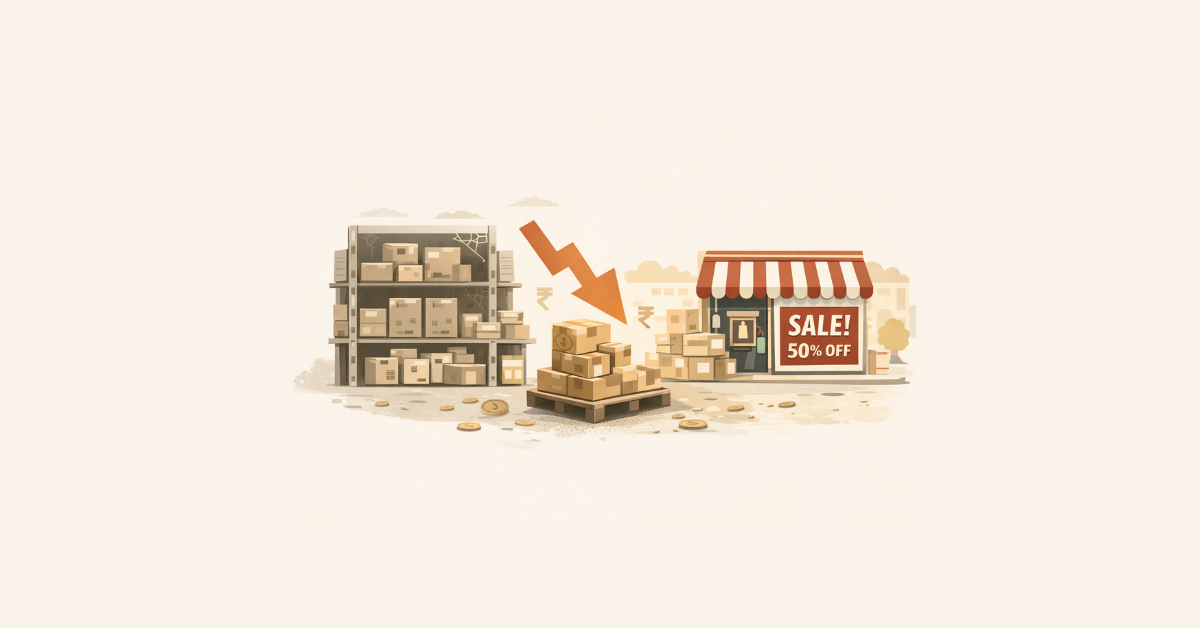
Dead stock is one of the most silent profit killers in Indian retail.
It doesn’t announce itself. It accumulates quietly—on shelves, in back rooms, inside godowns—until cash flow tightens and margins start bleeding.
Most retailers don’t create dead stock intentionally.
They inherit it from broken processes.


Let’s break down why dead stock happens in Indian retail, beyond surface-level reasons.
What Is Dead Stock in Retail?
Dead stock refers to inventory that has remained unsold for a long period and has little to no realistic chance of selling in the future.
In practical retail terms, dead stock means:
- Blocked working capital
- Rising storage and handling costs
- Forced discounting that erodes margins
- Shelf space occupied by items customers don’t want
Dead stock is not just an inventory issue—it is a cash flow issue disguised as stock.
1. Demand Forecasting Fails in the Indian Context
Most Indian retailers rely on instinct, last year’s sales, or supplier suggestions to plan inventory.
The problem?
Indian demand is not linear.
Sales fluctuate due to:
- Festivals
- Local events
- Exams and academic cycles
- Weather shifts
- Regional buying behaviour
When forecasting doesn’t account for these variables, retailers overestimate demand. Excess stock enters the system—and slowly turns dead.
Dead stock often starts as optimism, not negligence.
2. Overstocking Driven by Supplier Constraints
Many Indian retailers overstock not because they want to—but because they’re forced to.
Common triggers:
- Minimum Order Quantities (MOQs)
- Bulk discounts that look attractive on paper
- Long supplier lead times
- Fear of stockouts during peak demand
What looks like “smart buying” at procurement time often becomes unsellable stock at store level.
3. Inventory Visibility Gaps Hide the Problem
Dead stock rarely looks dead in reports.
Retailers using:
- Manual registers
- Spreadsheets
- Delayed stock updates
often don’t see ageing inventory clearly.
Without:
- Stock ageing reports
- Location-wise visibility
- SKU movement tracking
products remain invisible until they are written off or heavily discounted.
By the time dead stock is “noticed,” the damage is already done.
4. Product–Market Mismatch Is Underestimated
Indian consumers are extremely value-conscious and region-specific.
Dead stock frequently comes from:
- Wrong pack sizes
- Slight pricing mismatches
- Ignoring regional taste preferences
- Carrying SKUs that don’t differentiate
Even good products fail when they don’t fit the local catchment reality.
Retail failure is often about context, not quality.
5. Seasonality & Obsolescence Shrink the Selling Window
Certain categories have unforgiving timelines:
- Fashion
- Electronics
- Seasonal goods
- Festival-linked inventory
Miss the window, and the product instantly loses relevance.
Dead stock here is not gradual—it’s sudden.
6. Weak Store Execution Accelerates Stock Ageing
Sometimes stock doesn’t move simply because:
- It’s poorly placed
- Staff don’t push it
- There’s no upsell or cross-sell
- No incentive to recommend slow movers
If products aren’t actively sold, they silently age.
Dead stock is often a sales execution problem, not just inventory planning.
The Real Insight: Dead Stock Is a System Failure
Dead stock is rarely caused by a single mistake.
It emerges when:
- Forecasting is disconnected from reality
- Procurement ignores sell-through data
- Inventory visibility is delayed
- Sales teams lack guidance
- Decision-makers react too late
Retailers don’t need more stock.
They need more clarity.
How Modern Retailers Reduce Dead Stock
Retailers who control dead stock focus on:
- Real-time inventory visibility
- SKU-level movement tracking
- Faster decision cycles
- Data-backed procurement
- Mobile-first sales execution
Dead stock doesn’t disappear by discounting—it reduces when systems start talking to each other.
Final Thought
If your inventory looks healthy but cash feels tight,
dead stock is already inside your business.
The difference between struggling retailers and scalable ones isn’t experience—it’s control.