
Introduction
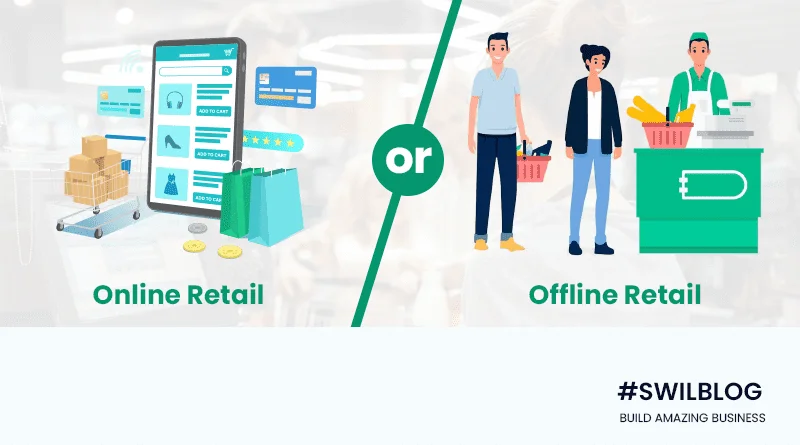
It can be very challenging to decide between starting a business through an online marketplace and selling in a conventional brick-and-mortar store. Additionally, it’s one of the most significant choices your business will ever be required to execute. The way you connect with customers, promote your products, and recruit new employees will change depending on whether you trade online or offline.

So, how do you make a decision? Before making the decision, you must weigh the benefits and drawbacks of both, which we’ve listed here. Additionally, you might not be required to make a decision.
Article Content-
Online vs. Offline
The majority of customers still prefer to purchase in-store, even though online shopping is expanding at an incredible rate. As a result, there are still plenty of options for businesses to benefit from both online and in-store sales. The decision you make will be influenced by your business, the products you provide, and the approach you wish to take with customers.
| Advantages of Online | Advantages of Offline |
| The advantages of online retailing are tremendous. With no need to invest in a huge physical area and all of the recurring fees that can come with it, opening an online store has much cheaper opening costs than opening a conventional physical store. As a result, you can start selling immediately and invest less capital in your business. Customers value e-commerce’s ease as well. Some customers may find purchasing from home far more appealing because there is no direct sales pressure and you can explore at your leisure. Then, it can be much more appealing to have things delivered directly to their home within a short period or even at a time that is convenient for the consumer.From a retailer’s perspective, precisely tracking a customer’s interactions with your business across a variety of platforms offers you access to information that can boost marketing efforts beyond what a conventional stores could handle. | The benefits of offline retail have actually been proven. Consumers still prefer this over other shopping options, and it currently offers a better customer experience than online shopping. You may give your customers a special experience and creatively showcase your brand with a classic brick-and-mortar store. Additionally, having an offline presence allows you to have immediate access to passersby without having to spend money on advertising. A fantastic retail shop can increase your local brand recognition and make you easily accessible to your target audience. |
| Disadvantages of Online | Disadvantages of Offline |
| Even though setting up an online store can be easier and faster than setting up a physical store, not having a physical location can make it more expensive to drive traffic to websites. In comparison to a brick-and-mortar store, you’ll have to accept that a massive advertising expense is needed. To let customers know you are a real business with a physical location and are fully operational, you’ll need to invest more time and funds in advertising. | The disadvantages of retail stores in comparison to online businesses are just as widely known as their benefits. Costs for setup and operation will undoubtedly increase. Compared to online retailers, traditional storefronts typically have higher monthly operating expenses due to the need to pay for things like rent, electricity, and water. This reduces the amount of room for error in your initial financial contribution. If you’re not careful, funding for an offline store can run out very fast. |
| Having no face-to-face interaction also makes it more challenging to develop genuine relationships with your customers. To boost confidence in your store and ensure customers that your business is on track, you’ll have to go above and beyond. | Additionally, for certain brick-and-mortar stores, location can be both a blessing and a burden. No matter how fantastic your product offering is, choosing the wrong location could seriously affect your business. Also, you do not influence what occurs in the surroundings of your store. It’s possible that a competitor will set up shop next door and steal your customers, or that the neighborhood’s upkeep will drive away potential customers. |
What should you consider?
However, after considering the relevant advantages and disadvantages, the decision between online and offline retail is usually still not clear. But do you really have a choice? Recently, it’s become more common for online businesses to invest in physical stores in addition to operating their online stores like traditional retailers. So, are you conducting both offline and online business?
Blurring the Line
The distinction between offline and online retail is becoming increasingly hazy. About 85% of customers expect a seamless experience on both. But as things stand today, barely 30% of people are receiving it. Retailers, both online and offline, have a chance to start fulfilling this need.
Customers can digitally interact in-store using tools like iBeacons to receive discounts based on the products they are looking at. Even social media platforms like Facebook are likely to be able to follow customers into physical stores as well as across the online platform. Retailers now have access to the customer data that retail businesses have enjoyed exclusively due to digital POS systems.
Future Omnichannel
Omni-channel is undoubtedly the future of commerce. Customers are connecting with retailers on a wide range of digital and physical platforms. They expect a similar experience in both. You must fulfill customer expectations at every stage, and multi-channel is the method to do this. Providing “click and collect” for your online customers, or encouraging them to obtain more product data online are just two examples.
Additionally, switching from online to physical stores is now much simpler for both parties. You may start a pop-up store as an online retailer or participate in local markets. You can sell online as an offline store on sites like eBay and Etsy for a small amount of money.
Conclusion
It’s still difficult to decide between offline and internet retail. The evaluation of how retailers may start to develop an omnichannel strategy and satisfy the evolving consumer’s expectations, however, may be the most ongoing priority for retailers. While it may not be practical for many retailers right now, it’s still something to consider.