


Retail Inventory Management is a critical aspect of any successful retail business, yet it’s often an area where hidden inefficiencies can lead to significant losses. Every retailer has that one cringe‑worthy moment: the day you realize the numbers on your shelf don’t match what your books say. For some shops, it’s a minor inconvenience. For others, like the one we’ll explore here, it meant five straight years of over‑orders, markdowns, and lost profit. This is their confession—and the simple fixes that can save you a world of headaches by improving your retail inventory management.
The Slow Unraveling: Why Good Retail Inventory Management Matters
It started innocently. A dozen missing shirts here, a few extra phone chargers there. Year after year, small discrepancies piled up. Managers chalked it up to human error or shrinkage. But behind the scenes…


- Over‑Ordering
“We kept replenishing stock we thought was sold,” admits the store owner. “So we doubled our warehouse space for nothing.” - Lost Sales
Conversely, high‑demand items repeatedly showed zero availability on the system, even though staff saw them in the back. Customers left empty‑handed. - Margin Erosion
Old stock went stale. Forced markdowns cleared years‑old inventory at steep discounts. Profits evaporated.
All because the method for counting stock was fundamentally flawed.
The Root Cause: Manual Pitfalls in Retail Inventory Management

1. One‑Person Counts
They began with a rotating single‑staff “stock day.” That person tallied and updated numbers alone—no second eye, no clear process.
- What went wrong: Fatigue, distraction, and simple miscounts.
- The fix: Two‑person counts with cross‑checks immediately catch mismatches.
2. Infrequent Audits
Once a quarter wasn’t enough. Seasonal launches and high sales volume created wild swings between counts.
- What went wrong: A three‑month gap turned small errors into big ones.
- The fix: Monthly or even weekly cycle counts on subsets of SKUs to keep data fresh.
3. Blind Spot on Returns
Returned items sat in a backroom pile, uncounted, until the next cycle count. Sometimes they never surfaced.
- What went wrong: Phantom stock that “disappeared.”
- The fix: Immediate return‑processing workflows that update system counts the moment items come back.
4. Static Spreadsheets
Counts went into Excel, then into the POS system by hand. One typo could skew hundreds of records.
- What went wrong: Manual data entry is error‑prone.
- The fix: Barcode scanners linked directly to your inventory system eliminate the middleman.
Turning It Around: Best Practices for Effective Retail Inventory Management
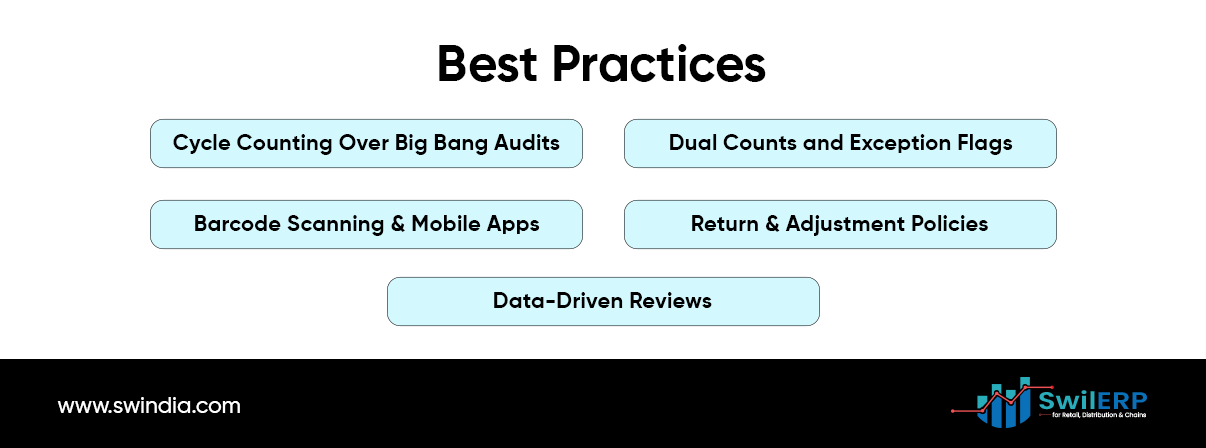
- Cycle Counting Over Big Bang Audits
Tackle 100 SKUs per week rather than 1,200 at month‑end. It’s faster, manageable, and catches errors sooner. - Dual Counts and Exception Flags
Two staff count independently. If numbers differ, the system flags only those SKUs for a third check—saving time and ensuring accuracy. - Barcode Scanning & Mobile Apps
Handheld devices scan items and update stock in real time. No paper, no spreadsheets, no guessing. - Return & Adjustment Policies
Create clear steps for handling returns or damaged goods. Count them immediately—and budget for small inevitable adjustments each cycle. - Data‑Driven Reviews
Current stock, fast-moving products, nil stock, self-expired stock — all in one glance to spot what’s selling and what’s stuck.
The Payoff: Real‑World Gains

After six months of implementing these changes, our retailer saw:
- Inventory Accuracy Jump to 98% (from 82%)
- 20% Reduction in Stock‑Related Write‑Downs
- 10% Increase in On‑Shelf Availability
- Fewer Customer Complaints About “Out of Stock”
That’s not just operational improvement—it’s direct impact on the bottom line.
Final Thoughts
If you’re still doing quarterly stock counts with pen, paper, and spreadsheets, you’re leaving money on the table. Modern retail is fast, and so must be your inventory controls. Start small: introduce cycle counts this month, add a scanner next month, and watch as accuracy climbs and headaches fade.
Because after five years of hidden losses, our retailer’s biggest confession wasn’t “We messed up.” It was “Why didn’t we do this sooner?”
Isn’t it time you found out?







This post really drives home the point that small discrepancies can quickly turn into bigger problems if they’re not addressed early on. Effective inventory management isn’t just about tracking stock—it’s about preventing those small losses from escalating.
A very insightful read on fixing retail inventory errors. The emphasis on automating processes and regular audits is especially useful for improving stock accuracy.