

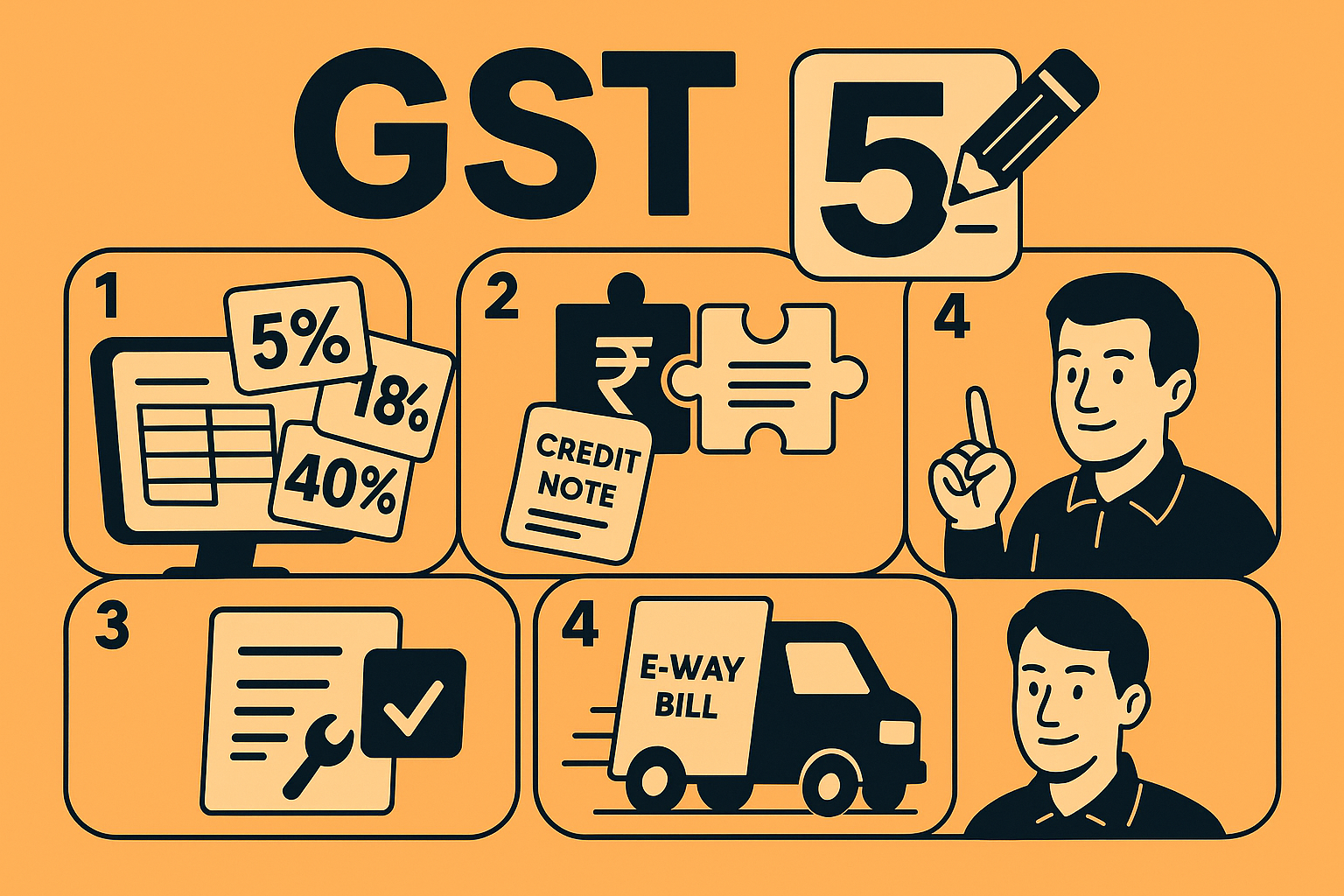
GST and Compliance in 2025 requires businesses to adapt quickly. With the rollout of GST 2.0, compliance is no longer just about filing returns once a month. The government has introduced real-time reporting, tighter invoice matching, and stricter penalties.
This means businesses can’t simply update tax slabs in their ERP systems and move on—they must also upgrade masters, enforce invoice workflows, automate reconciliations, tighten dispatch processes, and train staff.


In this guide, we break down the five urgent compliance steps every business should take immediately to stay safe under the new GST regime.
1. GST and Compliance in 2025: Update Masters and Billing Systems

Every error in GST starts from a wrong entry in your product or customer master. Under GST 2.0, mismatches will block your ITC instantly.
- Product Master: Update HSN codes and assign correct slabs (5%, 18%, 40%) to all SKUs.
- Customer Master: Validate GSTINs. Any mismatch will create rejections during GSTR-2B reconciliation.
- Invoice Templates: Add a clear GST breakup with slab percentages to avoid disputes.
Checklist:
- Export all masters before changes.
- Map HSN codes to new slabs using official annexures.
- Validate GSTIN for all active customers.
2. Strengthen Invoice and Credit Note Controls
GST 2.0 puts special focus on valuation rules and credit/debit notes.
- Post-sale discounts must be issued as credit notes linked to original invoices.
- ITC reversals for credit notes must be tracked in the same period.
- Debit notes for additional charges must also be linked directly.
👉 ERP Task: Enforce invoice linkage for every credit/debit note. Block free-text credit notes.
3. Automate Reconciliation of Returns
One of the most important aspects of GST and Compliance in 2025 is automated reconciliation. Manual reconciliation is no longer enough. Real-time matching means errors will block ITC and may trigger penalties.
- Sales side: Reconcile Sales Register vs GSTR-1 draft daily.
- Purchase side: Match Purchase Register vs GSTR-2B; flag missing invoices.
- Returns: Ensure GSTR-3B matches with GSTR-1 and 2B.
👉 Action: Schedule nightly reconciliation reports in your ERP and assign ownership.
4. Tighten Dispatch and E-Way Compliance
E-way bills and invoices must now align perfectly. Scrutiny is more automated.
- Every delivery challan must link to a tax invoice.
- Run daily Unbilled Dispatch Reports to ensure no challan is left without an invoice.
- High-value items under the 40% slab must always carry complete e-way bill documentation.
5. Train Staff and Communicate Internally
Technology alone isn’t enough—your team must understand the new compliance environment. Training your team ensures GST and Compliance in 2025 requirements are consistently met.
- Train billing staff on HSN selection and invoice generation.
- Train the accounts team on ITC reversal and credit note linking.
- Train the warehouse team on tagging pre-effective stock for audit clarity.
👉 Action: Issue a simple one-page SOP per team with examples (e.g., one for 5% essentials, one for 40% luxury).
Extra Tip: Keep an Audit File Ready
Always maintain a ready folder with:
- Pre- and post-GST 2.0 product master exports
- All credit/debit note reports with linked invoices
- Daily reconciliation reports (sales vs. GSTR-1, purchase vs. 2B)
- Tagged pre-effective stock list
This way, if scrutiny comes, you can show full compliance without panic.
Conclusion
GST 2.0 makes compliance real-time, automated, and stricter. In the long run, GST and Compliance in 2025 will separate proactive businesses from those struggling to catch up. Companies that invest in compliance systems, staff training, and ERP automation today will enjoy smoother audits, stronger vendor trust, and fewer financial risks. Treat compliance as a strategic investment, not just a regulatory requirement.
- Businesses that act fast—updating masters, enforcing credit note workflows, automating reconciliation, tightening dispatches, and training staff—will stay safe.
- Those who delay risk blocked ITC, notices, and penalties.
👉 Compliance is no longer just a filing exercise—it’s an everyday operational habit.