
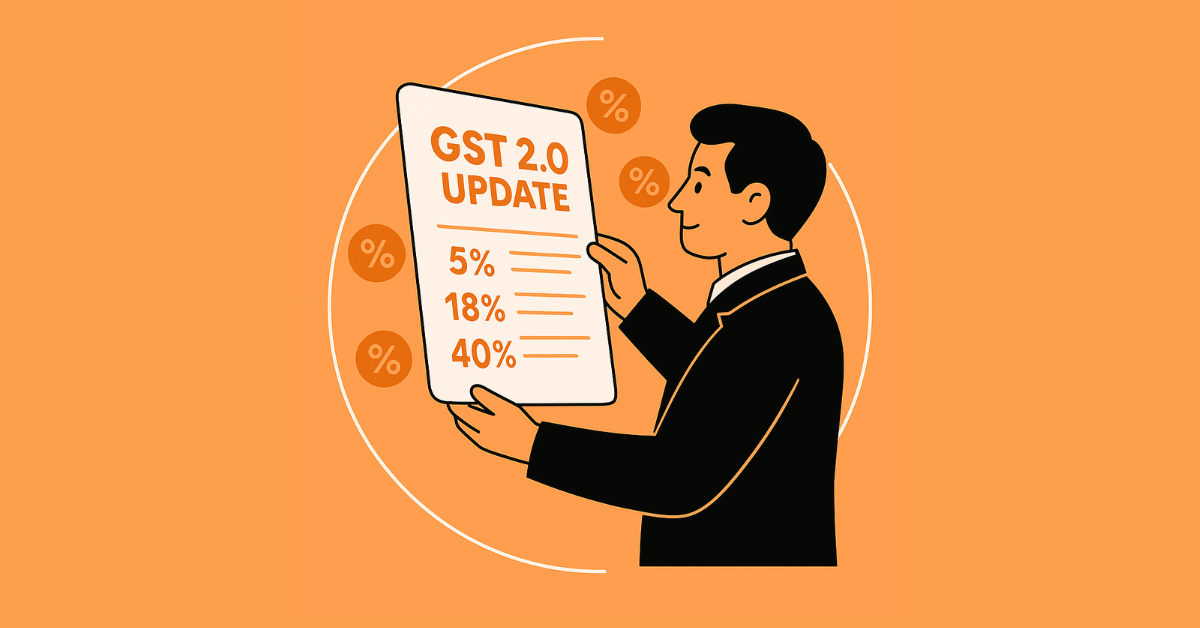
Based on the GST Council recommendations dated 3 September 2025. This guide explains the practical, technical impact for traders, retailers, distributors, manufacturers, and service providers. Where reforms touch accounting, invoicing, and compliance, you’ll find concrete steps to apply in your accounting or ERP system right away.
Use this as your single source while you adjust prices, update masters, train staff, and prepare filings. Deep dives are linked throughout:
- GST New Slabs 2025: What 5%, 18% & 40% Mean for Your Business
- What’s Cheaper and What’s Costlier After GST Changes?
- Impact of GST Update on Retailers, Wholesalers & Distributors
- GST & Compliance in 2025: 5 Urgent Steps Businesses Must Take Now
GST 2.0 Key Changes affect every business in India, from retailers to distributors.
Executive summary: what changed and why it matters

Rate rationalisation. GST slabs have been simplified and rebalanced. Many everyday and essential goods move to lower slabs (e.g., 5% or nil for some items), while a new 40% slab is introduced for certain luxury and sin categories. General goods largely fall into 18% where appropriate.
Legal & valuation updates. Amendments were recommended to valuation rules and to technical sections such as Section 15 and Section 34 of the CGST Act, and to the place-of-supply rule for intermediary services under the IGST Act. A practical result is cleaner treatment of post-sale discounts and clearer rules for intermediary exports.
Sector corrections. The Council corrected inverted duty structures in key sectors (e.g., certain man-made fibres and fertilizers), and adjusted rates for selected goods such as small cars, certain household appliances, and many processed food items.
Operational measures. Expect tighter invoice and ITC controls, clarified rules on specified premises for restaurants, and procedural changes that affect e-invoicing, refunds, and the matching of invoices for ITC claims.
Transitional & practical relief. For some packaging and stock labelling issues there is transitional relief, so unsold stock made before the effective date will not immediately require relabelling.
Practical impact (read this before you start)
Businesses must update product masters, pricing, invoices, and internal controls. Systems must be checked for HSN code mapping, credit note flows, invoice timestamps, and returns reconciliation. This is not only a tax change; it changes day-to-day accounting.
Core technical changes, explained
1. GST 2.0 Key Changes in Rate Rationalisation
GST 2.0 aims to reduce confusion by grouping many items into fewer, clearer slabs—two operational slabs for common goods, plus a high slab for specific goods and services.

What changed (in brief):
- A large set of items moved to 5% or nil where they are essential or labour-intensive (e.g., many processed foods, staples, certain agricultural equipment).
- 18% slab remains the main general rate for many consumer goods and services.
- One of the GST 2.0 Key Changes is the introduction of a 40% slab for luxury and sin goods and specific services such as certain betting and gambling services and related activities.
Why this requires action:
- Your invoicing logic must apply the new rate based on HSN. If your product master still uses the old rate, returns and ITC reconciliation will mismatch.
- Pricing and margin analysis needs re-running because effective buyer price changes when tax rates change.
Read next: GST New Slabs 2025: What 5%, 18% & 40% Mean for Your Business
2. HSN and product master updates
The Council published revised annexures listing HSN codes and their new treatment.
Immediate actions:
- Update HSN and GST rate fields in your product master so every SKU has the new tax rate assigned.
- If you use packing variants or combos, ensure the correct HSN is assigned for a composed supply.
- Maintain a change log of all updates for audit evidence.
ERP tasks:
- Export product master from ERP → map HSN → new rate → import back after validation.
- Test sample invoices before go-live to confirm tax calculation and totals.
📖 Step-by-step ERP guide: How to update latest tax slabs in SwilERP according to GST 2.0 rationalization
3. Post-sale discounts, credit notes & valuation (Sections 15 & 34)
Recommended legal changes make post-sale discount treatment clearer. Core idea: discounts reducing the value of supply must be recorded by issue of a GST credit note, and the recipient must reverse ITC when appropriate.
What this means in practice:
- If you give a post-sale discount that reduces invoice value, issue a GST credit note linked to the original invoice.
- Do not rely on informal spreadsheet adjustments.
- Recipient-side ITC reversal is required when value is reduced via credit note.
ERP tasks:
- Implement a workflow for generating and linking credit notes to original invoices.
- Add validations so credit notes cannot be created without reference to the invoice they amend.
- Auto-reconcile ITC reversal if your ERP tracks recipient-side ITC.
Read next: GST & Compliance in 2025: 5 Urgent Steps Businesses Must Take Now
4. Place of supply for intermediaries (IGST Section 13(8))
A technical but important fix: recommended omission of a clause in Section 13(8) so place of supply for intermediary services is the location of the recipient under the default rule (Section 13(2)). For exporters of intermediary services this clarifies export treatment.
ERP effect:
- If you sell intermediary services across borders, update the place-of-supply logic in your billing engine to use the recipient location rule.
- Confirm export zero-rating or refund eligibility if this change affects your trade flows.
5. Inverted duty and sector corrections
Several sectors had inverted duty structures (input taxes > output tax), causing blocked credits and distortions. The Council adjusted rates in sectors such as man-made textiles, fertilizers, and renewable energy components.
Action:
If you operate in affected sectors, run a mid-year review of purchase vs sales tax incidence. Adjust procurement, pricing, and inventory policies accordingly.
6. E-invoicing, e-way bill & reporting changes
Recommendations emphasize more automated reporting and reconciliation.
Points to note:
- Steps strengthen invoice-level traceability. If e-invoicing thresholds or notification lists change in final notifications, be ready to produce IRN and map your invoice flow.
- E-way and invoicing data must be aligned. If dispatches use challans, link them to invoices so e-way bills and GST returns reconcile.
ERP tasks:
- Confirm e-invoice settings and IRN generation flows.
- Link delivery challans and invoice numbers in system; run reports for unbilled dispatches.
- Schedule automated daily checks comparing sales register vs e-invoice issuance.
Retailers must adapt quickly to GST 2.0 Key Changes in billing and pricing systems.
7. ITC matching and refunds
GST 2.0 tightens invoice-level matching for ITC claims and clarifies cases where provisional refunds may be restricted in favour of on-scrutiny review.
Practical advice:
- Ensure purchase invoices are uploaded with correct GSTIN and invoice numbers so they auto-populate recipient returns.
- Maintain supporting documents for larger ITC claims and keep a clear audit trail for return of taxes/refunds.
ERP help:
- Use supplier master validation, require GSTIN validation at entry, and keep a “missing invoices” report for unmatched purchase lines.
8. Compliance enhancements: restaurants & specified premises
Recommended clarifications to the definition of “specified premises” so that stand-alone restaurants do not claim the specific 18% with ITC option meant for certain premise-based services.
Action:
If you operate restaurants or catering, check the new definition in the notification and adjust billing and tax choice accordingly.
Transitional relief: old stock, labels & pricing displays
There is practical leeway for packaged goods manufactured or packed before the effective date. This reduces immediate relabelling costs. Still, be careful about invoicing and price display rules when old stock is sold after the rate change.
What to check now:
- Date of manufacture and sticker rules for pre-packed goods; note any time-limited relief.
- System control: invoice tax should follow the tax rate applicable on date of supply or by law. ERP should compute based on invoice date.
ERP action:
- Tag inventory received before effective date (“pre-GST2.0 stock”).
- Run pre-effect stock reports to quantify inventory under transitional relief.
Monthly compliance flow (operator checklist)
Pre-close checks (T-3 days):
- Reconcile sales register vs GSTR-1 draft; flag missing invoices.
- Reconcile purchase register vs supplier data for ITC.
- Ensure all credit notes are linked and posted.
Finalise invoices:
- Confirm invoice dates, HSN codes, GSTINs are accurate.
- Ensure post-sale discounts are issued as GST credit notes.
Complete e-invoice & e-way steps:
- Generate IRNs (if applicable) and ensure e-way bills are linked.
File returns (with backups):
- Keep copies of export/refund documentation.
- Maintain records supporting ITC claims.
Your ERP should automate much of this via scheduled reconciliation, validation checks, and audit logs.
ERP admins & accountants: step-by-step plan
Immediate (next 48–72 hours):
- Export product master; update HSN and tax slab columns with new rates from the official annexure.
- Tag pre-effective stock (“pre-GST2.0 stock”) for special handling.
- Validate supplier GSTINs in supplier master; fix invalid/missing entries.
- Turn on invoice validations that prevent saving invoices without HSN or tax rate.
Short term (this week):
5. Configure credit note workflow so every credit note is linked to a parent invoice and has a reason code.
6. Implement an “unbilled dispatch” report: list delivery challans without an invoice; assign owners to clear daily.
7. Set up a GSTR-1 vs Sales Register reconciliation report and schedule nightly.
Medium term (2–6 weeks):
8. Re-run pricing & margin reports across SKUs; identify lines needing price adjustments or promotions.
9. Train billing/counter staff on new HSN rules and on capturing full GSTIN for B2B.
10. Update templates for invoices and POS receipts, per notification.
Ongoing:
11. Run weekly dead-stock vs fast-moving comparisons to improve cash flow and stocking decisions.
12. Keep audit logs & version history of master updates and invoice edits.
Resources for ERP users:
Sector-specific notes that matter
Pharmacies & healthcare. Many life-saving drugs and certain medical supplies see movement to lower or nil rates. Maintain a separate product list and highlight nil-rated items to pass savings to customers.
Food & grocery. Several packaged/cooked food items move to 5% or nil. Update recipe/BOM entries so margins remain coherent.
Automotive & appliances. Changes for small cars, ACs, and TVs affect high-value billing. Check registration and scheme implications for exchange/discount programmes.
Agriculture & renewable energy. Reduced rates on farm machinery and renewable components correct inverted duty and may make procurement more economical.
Common pitfalls to avoid
- Updating only some SKUs. Partial updates create mismatches—update all product masters and test invoices.
- Not tagging pre-effective stock. Leads to wrong sticker/pricing decisions at sale time.
- Free-form credit notes. Every discount must be tracked and linked.
- Delayed staff training. Manual bypasses create reconciliation failures.
- Ignoring e-way vs invoice linkage. Dispatch without invoice leads to return mismatches.
Practical team checklist (copy–paste)
Before the next bill cycle
- Product master HSN & rate updated for all SKUs
- Supplier GSTINs validated and corrected
- Credit note workflow activated & enforced
- Unbilled dispatch report scheduled daily
- GSTR-1 vs Sales Register report scheduled nightly
- Tagging applied to pre-effective stock
Operational controls
- Block edits to closed tax periods (or require reason + approval)
- Auto-check rounding rules across billing and returns
- Set alerts for items where tax change creates negative margins
Pricing, MRP & customer communication
- Retail pricing: Where tax rate falls, either reduce price or hold margin—decide policy and update price lists centrally.
- Labels & MRP: Use transitional relief carefully. Communicate clearly when price changes are passed on; budget for reprints if relief ends.
- Customer notices: When essentials become cheaper, inform customers (goodwill). For increases (e.g., items in 40% slab), give advance notice and explain it’s a tax policy change.
Audit readiness & documentation
Keep these ready:
- Dated export of product master before & after rate updates
- List of credit notes with linked invoice numbers and reasons
- Tagging report for pre-effective stock and dispatch dates
- Reconciliation report showing GSTR-1 vs sales register and corrective actions taken
FAQs businesses commonly ask
Q. Which date’s rate applies when an invoice spans the effective date?
A. Tax is typically applied on the date of supply or invoice, depending on law and supply type. Tagging pre-effective stock helps apply the right rule. When in doubt, follow the notification language and seek advice from tax counsel.
Q. Do I need to relabel all packed goods immediately?
A. The Council provided limited relief for pre-packed stock. Inventory records must show manufacture/packing date, and price display must meet transitional rules. Check the exact notification for allowed timelines.
Q. Will ITC be blocked more often now?
A. Not necessarily. The change aims to improve matching. If invoices are uploaded correctly and credit-note links are maintained, ITC flow should be smoother. Risk rises only when purchases are not entered correctly.
Closing note: 30-day execution plan
Day 1–3: Freeze changes; export product & supplier masters; update rates & GSTINs; deploy daily reconciliations.
Week 1: Activate credit-note controls; link delivery challans → invoices; run test invoices; reconcile to draft return.
Week 2: Push pricing updates; update POS templates; train counters.
Week 3–4: Monitor two weekly reconciliation cycles; fix mismatch patterns; document SOPs for common fixes.
More from the blog
 Distribution & Supply ChainGSTR-2B Reconciliation for Distributors: How to Protect Your ITC Before You File GSTR-3B
How distributors reconcile purchases with GSTR-2B before filing GSTR-3B, fix ITC mismatches, and keep books their CA can trust. India, 2026.
Read article Distribution & Supply ChainGoods Inward Done Right: Matching Every Purchase Order to the GRN in a Distribution Business
Booked one thing, received another? See how PO-to-GRN matching catches shortages, wrong rates and near-expiry stock at goods inward, in one core.
Read article Distribution & Supply ChainSecondary Sales Reporting for Distributors: How to Track Sell-Through Your Principals Can Trust
See real sell-through without a bolt-on DMS. How Indian distributors capture salesman and B2B orders and report secondary sales from one operational core.
Read article PharmacyManaging Expiry Returns in Pharma Distribution: How to Recover Value from Near-Expiry Stock
How pharma distributors handle near-expiry stock, saleable vs non-saleable returns, breakage claims and expiry credit notes without losing money or ITC.
Read article Distribution & Supply ChainMoving from Tally to a Distribution ERP: When You've Outgrown the Books
The honest signs a distributor has outgrown Tally, what a distribution ERP adds, and how to migrate in phases without stopping billing.
Read article Distribution & Supply ChainTablet-Based Picking in the Warehouse: How Device Setup Drives Real-Time Fulfilment Performance
Tablet picking lifts accuracy and live stock visibility, but only if the picker hardware fits the job. Device minimums, zone flows, and fixed-station picking wi…
Read article
- Distribution & Supply ChainGSTR-2B Reconciliation for Distributors: How to Protect Your ITC Before You File GSTR-3B
How distributors reconcile purchases with GSTR-2B before filing GSTR-3B, fix ITC mismatches, and keep books their CA can trust. India, 2026.
Read article - Distribution & Supply ChainGoods Inward Done Right: Matching Every Purchase Order to the GRN in a Distribution Business
Booked one thing, received another? See how PO-to-GRN matching catches shortages, wrong rates and near-expiry stock at goods inward, in one core.
Read article - Distribution & Supply ChainSecondary Sales Reporting for Distributors: How to Track Sell-Through Your Principals Can Trust
See real sell-through without a bolt-on DMS. How Indian distributors capture salesman and B2B orders and report secondary sales from one operational core.
Read article - PharmacyManaging Expiry Returns in Pharma Distribution: How to Recover Value from Near-Expiry Stock
How pharma distributors handle near-expiry stock, saleable vs non-saleable returns, breakage claims and expiry credit notes without losing money or ITC.
Read article - Distribution & Supply ChainMoving from Tally to a Distribution ERP: When You've Outgrown the Books
The honest signs a distributor has outgrown Tally, what a distribution ERP adds, and how to migrate in phases without stopping billing.
Read article - Distribution & Supply ChainTablet-Based Picking in the Warehouse: How Device Setup Drives Real-Time Fulfilment Performance
Tablet picking lifts accuracy and live stock visibility, but only if the picker hardware fits the job. Device minimums, zone flows, and fixed-station picking wi…
Read article