
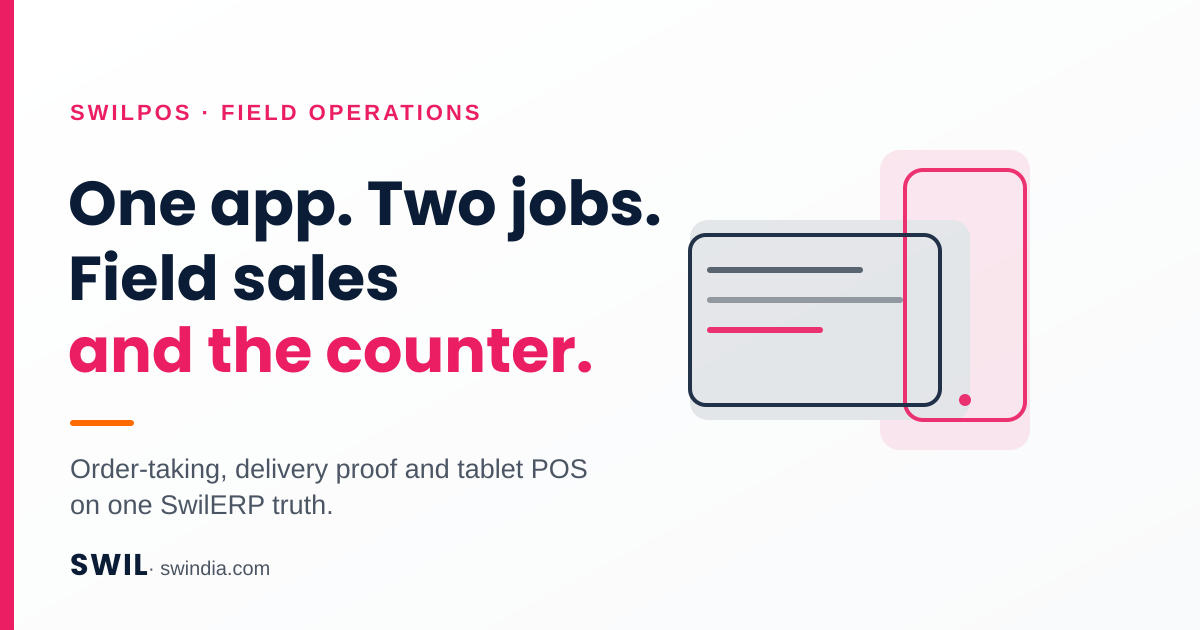
SwilPOS for Field Operations: Tablet POS, Field Sales and Delivery Fulfilment in One App
Your sales executive is standing inside a retailer's shop. The retailer wants 40 cases, and he wants to know the rate and whether you can deliver tomorrow. So the executive does what he does ten times a day: he calls the office. Someone walks to the billing computer, reads out the stock, reads out the rate, and the executive writes it on a pad. By the time that pad reaches your billing desk, two lines have changed and one item is already out of stock.
Meanwhile your delivery boy has left with a stack of paper challans. He will collect cash at three doorsteps, get signatures on two, lose one slip, and reconcile the whole thing from memory tonight.
This is how most distribution businesses in India still run their field. Not because the owners are careless, but because the tools were never built to work together. There is one app for the salesman, a different app for the delivery boy, and the billing software that talks to neither.
SwilPOS exists to end that. One app, two jobs: the field and the counter, both running on the same SwilERP truth.
The hidden cost of running your field on three different apps
Walk through what a typical setup actually costs you, beyond the licence fees.
The order-taking app that does not know your stock. Sales-force apps are good at beat plans and capturing orders. The problem is what happens after the order is captured. It sits in a sales system that has no live view of your godown, so your executive promises stock you do not have, or skips an SKU he assumes is finished. The order then has to be re-keyed into billing, where the errors surface for the first time.
The delivery slip that travels on paper. A separate delivery or proof-of-delivery app might track the van on a map, but it does not know the customer's outstanding, the rate, or what was actually billed. So the delivery boy carries paper, collects cash against a number nobody verified at the door, and your accounts team spends the next morning matching slips to invoices.
Three apps, three versions of the truth. Field orders live in one system, deliveries in another, billing and stock in a third. Your item master, your prices, and your party outstanding now exist in three places, and they drift apart a little more every week. The reconciliation work you are paying staff to do is the cost of the gap between those apps.
You did not choose this mess. It accumulated, one point-solution at a time.

One app, two jobs: what SwilPOS actually does
SwilPOS is SWIL's edge application for retail and field. It runs fast checkout at the counter, a compact tablet POS for secondary lanes, and the mobile workflows your salesmen and delivery staff use on the move. All of it stays in live integration with SwilERP for stock, pricing, vouchers, and masters.
Here is what that looks like for each person who touches it.
For the sales executive on the move
The executive opens SwilPOS in the retailer's shop and works against live or queued ERP data, not a guess. He can:
- Capture the order on the spot, van-sales style, with the catalogue and current stock in front of him.
- See real stock and the correct rate before he commits to anything, so he stops over-promising on out-of-stock items.
- Pull up that party's history and outstanding, so the credit conversation happens at the counter, not after the goods have shipped.
- Sync it back to SwilERP instantly, so billing sees the real order, not a re-typed approximation of it.
Create or correct a customer on the device too, within whatever role limits you set, so a new retailer or a changed delivery address does not wait for the office to update a master.
For the delivery boy at the door
Delivery and dispatch used to be a separate SWIL product called SwilDispatch. It is gone now. All of that lives inside SwilPOS, next to billing, which is the point. The delivery boy gets an assigned worklist with route-style execution. Each drop moves through clear status: packed, out for delivery, delivered, with proof of handoff captured at the door. He can take payment at the doorstep by cash or UPI, against the same invoice and the same outstanding the office sees. No paper challan to lose, no end-of-day reconstruction from memory.
For the counter
The same app runs a proper tablet POS. When you need a second billing lane during a rush, a counter at an exhibition, a shop-in-shop, or a compact back-store till, you do not buy a separate register and a separate system. You put SwilPOS on a 7 to 10 inch tablet with a Bluetooth scanner and bill on the same stock and price rules as your main counter.
Why "on one ERP truth" is the whole point
Everything above only works because SwilPOS is not a standalone app. It requires SwilERP and runs on it.
That dependency is the feature, not a limitation. There is one item master, one stock figure, one customer record, one outstanding. When the executive takes an order in the field, it draws from the same stock the counter sees. When the delivery boy collects ₹8,000 at a doorstep, it posts against the same invoice your accounts team has open. Nobody is syncing three systems at night and arguing about which one is right.
Every business challenge has a Swil product. And they all already work together.

That is the difference between a system and a pile of apps that share a login.
Built for how the field actually works in India
Field work does not happen in places with reliable internet. A distributor's beat runs through markets where the signal drops between two shops.
SwilPOS is built for that. It queues transactions on the device and replays them to central SwilERP when connectivity returns, so an order taken in a no-network basement market is not lost, it just syncs a few minutes later. It runs on standard Android phones for your field and delivery staff and on Android tablets for the counter, so you are not buying exotic hardware. Within your policy and role rights, you get GPS-style location visibility for salesmen and delivery personnel, so dispatch can see movement against a beat or a delivery run instead of only the last counter someone touched. Basic attendance is built in, clock-in and clock-out for staff who never sit at a back-office terminal, which means one less separate app to manage.
And the reports your field staff actually need ride along with them: outstanding by party for the collection conversation, a party's own history, stock by location, and product with batch detail where your inventory carries it, which matters when a delivery is pharma or any other batch-tracked line.
Where SwilPOS ends and the rest of the ecosystem begins
SwilPOS is deliberately scoped. It owns the counter, the field, the delivery, and the tablet. It does not try to be your warehouse floor system, and that honesty is worth something.
When your picking gets heavy, the warehouse pick, review, and pack work is SwilSort, running on the same core. When you want to sell online and fulfil those orders from store stock, that is SwilMart. When you want to see the whole business from your phone as an owner, that is SwilBA. Every one of them sits on SwilERP as the foundation.
This is the part most distributors miss when they buy a field app in isolation. You are not just solving today's order-taking problem. You are deciding whether your next problem, the warehouse, the online channel, the second branch, will mean another vendor and another migration, or just the next product on a platform you already run. With SWIL it is the latter. Start where you are, grow as far as you want, and do not switch.
That promise is not a slogan we printed last quarter. It comes from 30 years of building for Indian trade and 35,000-plus businesses onboarded across that time, with 18,000-plus active customers running on the platform today. The depth shows up in the boring places: how a partial return posts, how a scheme price flows to the field, how an outstanding follows a customer from the counter to the doorstep.
A short checklist before you buy a field app
If you are evaluating tools for your field and delivery team, ask each vendor these five questions:
- Does the order my executive takes draw from real, live stock, or a copy that syncs later?
- Can the delivery boy take a doorstep payment against the actual invoice, not a separate slip?
- Is delivery and dispatch built into the same app as billing, or is it a bolt-on?
- Does it work when the network drops, and does nothing get lost?
- When I grow into a warehouse or an online channel, do I add a module or replace the vendor?
If the answers point to three apps stitched together, you already know what next year's reconciliation will cost.
Put your field team on one app
Your field is too important to run on paper slips and phone calls. Talk to a SWIL partner near you about moving your sales executives, your delivery team, and your counter onto SwilPOS, on the SwilERP core you may already be running. They speak your language, they will set it up in your shop, and they will train your staff in person.
Talk to a SWIL partner about SwilPOS and see what one connected app does to your order errors, your delivery proof, and your night-time reconciliation.
Already running SwilPOS at the counter? Read [Why Modern Retailers Need SwilPOS: Mobile Billing, Inventory and Team Tracking](https://www.swindia.com/blog/why-modern-retailers-need-swilpos) for the in-store side of the story.
More from the blog
 Distribution & Supply ChainGSTR-2B Reconciliation for Distributors: How to Protect Your ITC Before You File GSTR-3B
How distributors reconcile purchases with GSTR-2B before filing GSTR-3B, fix ITC mismatches, and keep books their CA can trust. India, 2026.
Read article Distribution & Supply ChainGoods Inward Done Right: Matching Every Purchase Order to the GRN in a Distribution Business
Booked one thing, received another? See how PO-to-GRN matching catches shortages, wrong rates and near-expiry stock at goods inward, in one core.
Read article Distribution & Supply ChainSecondary Sales Reporting for Distributors: How to Track Sell-Through Your Principals Can Trust
See real sell-through without a bolt-on DMS. How Indian distributors capture salesman and B2B orders and report secondary sales from one operational core.
Read article PharmacyManaging Expiry Returns in Pharma Distribution: How to Recover Value from Near-Expiry Stock
How pharma distributors handle near-expiry stock, saleable vs non-saleable returns, breakage claims and expiry credit notes without losing money or ITC.
Read article Distribution & Supply ChainMoving from Tally to a Distribution ERP: When You've Outgrown the Books
The honest signs a distributor has outgrown Tally, what a distribution ERP adds, and how to migrate in phases without stopping billing.
Read article Distribution & Supply ChainTablet-Based Picking in the Warehouse: How Device Setup Drives Real-Time Fulfilment Performance
Tablet picking lifts accuracy and live stock visibility, but only if the picker hardware fits the job. Device minimums, zone flows, and fixed-station picking wi…
Read article
- Distribution & Supply ChainGSTR-2B Reconciliation for Distributors: How to Protect Your ITC Before You File GSTR-3B
How distributors reconcile purchases with GSTR-2B before filing GSTR-3B, fix ITC mismatches, and keep books their CA can trust. India, 2026.
Read article - Distribution & Supply ChainGoods Inward Done Right: Matching Every Purchase Order to the GRN in a Distribution Business
Booked one thing, received another? See how PO-to-GRN matching catches shortages, wrong rates and near-expiry stock at goods inward, in one core.
Read article - Distribution & Supply ChainSecondary Sales Reporting for Distributors: How to Track Sell-Through Your Principals Can Trust
See real sell-through without a bolt-on DMS. How Indian distributors capture salesman and B2B orders and report secondary sales from one operational core.
Read article - PharmacyManaging Expiry Returns in Pharma Distribution: How to Recover Value from Near-Expiry Stock
How pharma distributors handle near-expiry stock, saleable vs non-saleable returns, breakage claims and expiry credit notes without losing money or ITC.
Read article - Distribution & Supply ChainMoving from Tally to a Distribution ERP: When You've Outgrown the Books
The honest signs a distributor has outgrown Tally, what a distribution ERP adds, and how to migrate in phases without stopping billing.
Read article - Distribution & Supply ChainTablet-Based Picking in the Warehouse: How Device Setup Drives Real-Time Fulfilment Performance
Tablet picking lifts accuracy and live stock visibility, but only if the picker hardware fits the job. Device minimums, zone flows, and fixed-station picking wi…
Read article