
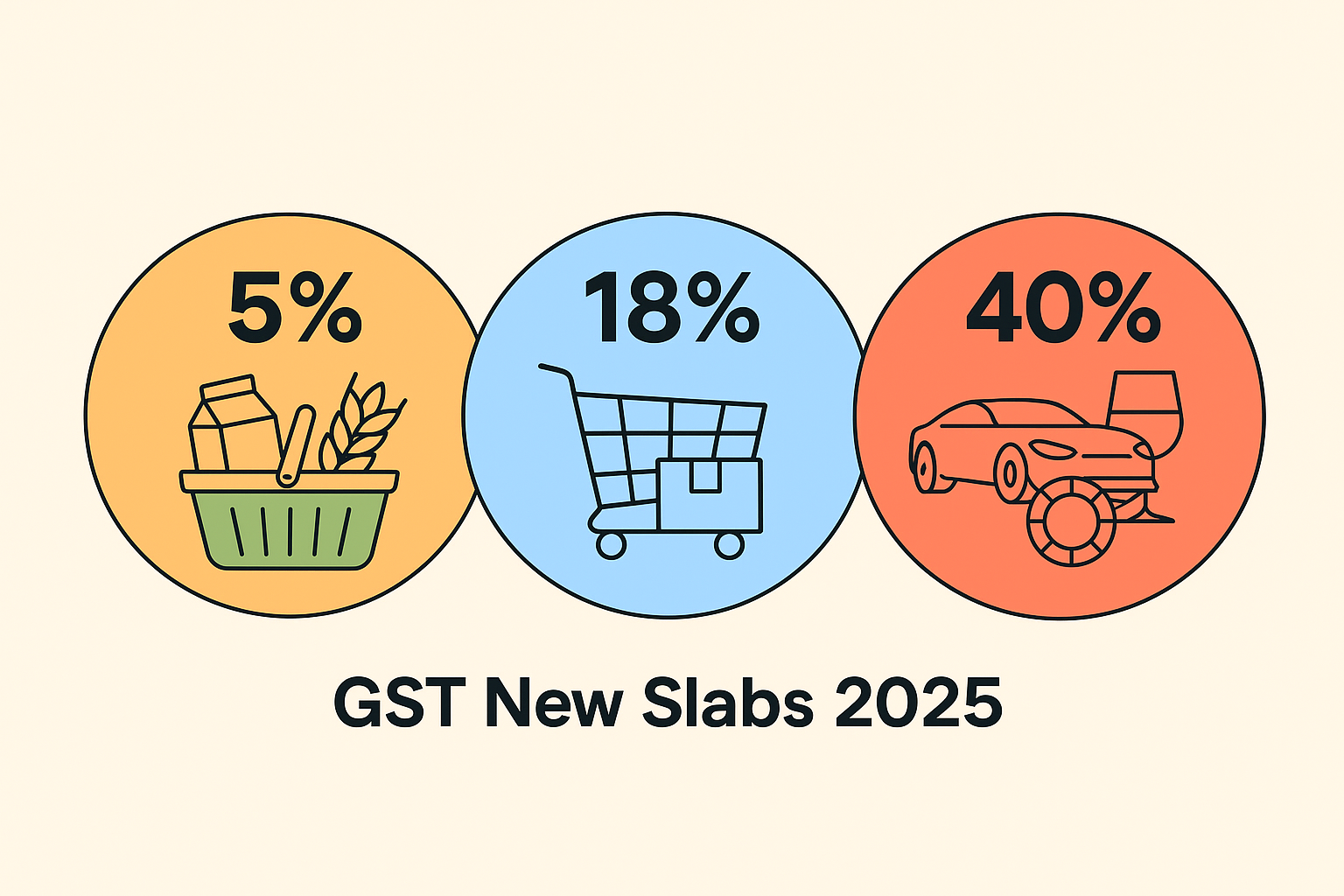
GST New Slabs 2025 have changed how businesses look at pricing, taxation, and compliance. One of the most impactful changes was the rationalization of tax slabs, which now focus on three main categories—5%, 18%, and 40%.
For businesses, this change is more than just a new percentage. It affects pricing, invoicing, ITC reconciliation, ERP/POS configuration, and customer communication. Whether you run a pharmacy, supermarket, electronics store, distribution network, or service business, you’ll need to re-map your product masters, update rate logic in your systems, and train staff for compliance. Retailers must align billing systems to the GST New Slabs 2025 to avoid tax mismatches.
This guide breaks down:
- What each slab (5%, 18%, 40%) is intended for
- Which categories of goods and services are impacted
- The immediate steps you must take in your ERP/POS systems
- How the new slabs will affect pricing, MRP, margins and ITC
- Sector-specific insights for retail, pharma, grocery, electronics, auto, agriculture, and renewables
By the end, you’ll know exactly what the new slabs mean for your business and how to prepare without costly mistakes.
Quick View: The Three Operational Slabs
SlabHigh-Level IntentTypical Coverage Snapshot*What You Must Update
5%
Essentials & priority items
Common foods, some agri items, selected daily-use categories
Product masters, price lists, shelf labels, POS tax mappings
18%
General goods & services
Most consumer goods, standard services
Default tax mapping for unlisted items
40%
Luxury & sin categories (narrow, notified)
Selected luxury goods and specified services
Special pricing, invoice templates, e-way/e-invoice checks, compliance notes
*Always use the official notifications’ annexures to confirm HSN for your SKUs before updating.
Impact of GST New Slabs 2025 on Retailers and Distributors
- Many items have moved into 5% or stayed in 18% to make billing simpler.
- One of the most debated GST New Slabs 2025 is the 40% rate on luxury goods
- HSN mapping drives the tax, not the brand or MRP. If an HSN shifts slab, your invoice must reflect the new rate.
- Many SMEs are revising their price lists to align with GST New Slabs 2025.
👉 Bottom line: Correct HSN + correct rate on the invoice date. Everything else follows from that.
For FMCG retailers, GST New Slabs 2025 provide clarity on margin adjustments.
Effective Date & Transition
- Apply the new rate on supplies made on/after the notified effective date.
- For pre-packed goods made before that date, limited relabelling relief may apply. Keep proof of manufacturing/packing date with batch details.
- If you issue credit notes for earlier invoices, always link them to the original invoice so returns & ITC remain accurate.
Who Needs to Act Immediately
- Retailers (pharmacy, grocery, electronics, lifestyle): Update POS tax mappings, shelf labels, online product pages.
- Wholesalers & distributors: Refresh price lists, dealer agreements, auto-reorder rules.
- Service providers: Check place-of-supply logic & notified rate changes.
- Accounts & compliance teams: Re-run GSTR drafts, ITC matching, credit/debit note flows.
Step-by-Step: How to Update Your System Safely
- Export product master with HSN, current tax rate, MRP/SRP, and pack details.
- Create a mapping file: HSN → new slab (5%, 18%, 40%) as per annexures.
- Dry-run in test company: post 10–20 invoices across categories.
- Lock backdated edits for the prior month to protect audit trail.
- Go live + issue team SOP (mixed supplies, price overrides, returns).
- Monitor daily for 14 days: run Sales Register vs GSTR-1 draft and “rate deviation” reports.
Pricing Impact: Simple Calculation Patterns

- Case A: Item moved to 5%
- Base price same → consumer price falls.
- MRP same → margin rises (decide policy category-wise).
- Case B: Item at 18% (unchanged)
- No tax change, but check combos/bundles. Ensure correct principal supply HSN.
- Case C: Item notified at 40%
- Re-price immediately, display separately.
- Check service charges, warranties, accessories for separate tax treatment.
Day-to-Day Changes in Billing & Returns
- Invoices: Correct HSN, slab, invoice date = non-negotiable.
- Credit notes: Required for post-sale discounts reducing taxable value; must link to original invoice.
- Debit notes: Use when value increases post-supply.
- Round-off: Keep a single rule across billing & returns to avoid mismatch.
Inventory & MRP Labels
- Tag pre-effective stock. Record batch/pack dates if transitional relief applies.
- Update shelf talkers & digital displays.
- For online catalogues, refresh tax, price, GST breakup.
ITC Considerations You Should Not Miss
- Purchase side: Suppliers must issue invoices with new rate + correct HSN.
- Returns & expiries (pharma/FMCG): Record credit notes + ITC reversal where needed.
- Inverted duty correction: If blocked credits now align, re-assess pricing & stock depth.
Special Notes by Segment
- Pharmacy & healthcare: Many life-saving drugs reduced; maintain batch-wise masters with HSN, GST%, expiry.
- Grocery & food: Essentials now 5%/nil; be careful with meal kits, hampers, combos.
- Electronics & appliances: Watch slab shifts (TVs, ACs, refrigerators). For bundles (device + warranty + install), bill separately to avoid wrong tax.
- Auto & spares: Keep part-level HSNs clean; one wrong carry-over multiplies errors.
- Agri & renewables: Duty correction improves margins; pass some benefit to scale.
Mixed Supplies, Combo Packs & Kits
- Identify principal supply: if bundle priced as one, tax follows principal supply.
- If separately priced: each line = own HSN + rate.
- Build internal list of “bundled SKUs” with fixed tax logic.
Common Mistakes That Trigger Notices
- Using old rate because HSN not updated.
- Issuing credit notes without linking to parent invoice.
- Unbilled dispatches: challans not invoiced within return period.
- Wrong GSTIN entries on B2B invoices.
- Round-off mismatches between POS & return working.
👉 Add weekly controls: Sales Register vs GSTR-1 + Purchase Register vs 2B auto-match.
Store-Floor Playbook (Retail)
Before opening Day 1:
- Replace shelf labels for 5% items; tag “New Price” where benefit passed.
- Train cashiers to spot 40% items & follow SOP.
- Update display for combos/offers with separate receipt lines.
During Week 1:
- Run daily exception report: invoices with manual rate overrides, negative margins, high discounts.
- Check top 50 SKUs by volume for correct tax.
Distributor Playbook (B2B)
- Issue revised dealer price list with new tax column + effective date.
- Update credit terms if input costs changed.
- Enable self-service order portals to reflect live prices instantly.
- Share one-page GST change memo with examples per category.
ERP/POS Configuration Checklist
- ✅ Update product master: HSN + new slab for every SKU
- ✅ Lock edits to closed months; require approval for backdated changes
- ✅ Enforce credit-note linkage to original invoice
- ✅ Single round-off rule across billing & returns
- ✅ Create “Unbilled Dispatches” report (challan → invoice)
- ✅ Schedule daily Sales Reg vs GSTR-1 + Purchase Reg vs 2B
- ✅ Refresh invoice/receipt templates showing GST breakup
- ✅ Export pre-effective stock list with batch/pack date
- ✅ Train counter staff; issue 2-page SOP for mixed supplies/combos
FAQs
Q. Do I need to reissue invoices for sales before the effective date?
No. Old rate applies for supplies before effective date. New slab applies only afterward.
Q. Can I keep MRP same even if GST falls to 5%?
Yes. If you keep MRP, your margin rises. If you drop it, you pass benefit to customers.
Q. How do I handle a bundle with items at 5% and 18%?
If billed separately: each line = own HSN + rate. If single-price bundle: apply principal supply rules.
Q. What if a supplier still uses old rate on purchase invoices?
Ask for corrected invoice. Wrong purchase tax breaks ITC matching later.
More from the blog
 Distribution & Supply ChainGSTR-2B Reconciliation for Distributors: How to Protect Your ITC Before You File GSTR-3B
How distributors reconcile purchases with GSTR-2B before filing GSTR-3B, fix ITC mismatches, and keep books their CA can trust. India, 2026.
Read article Distribution & Supply ChainGoods Inward Done Right: Matching Every Purchase Order to the GRN in a Distribution Business
Booked one thing, received another? See how PO-to-GRN matching catches shortages, wrong rates and near-expiry stock at goods inward, in one core.
Read article Distribution & Supply ChainSecondary Sales Reporting for Distributors: How to Track Sell-Through Your Principals Can Trust
See real sell-through without a bolt-on DMS. How Indian distributors capture salesman and B2B orders and report secondary sales from one operational core.
Read article PharmacyManaging Expiry Returns in Pharma Distribution: How to Recover Value from Near-Expiry Stock
How pharma distributors handle near-expiry stock, saleable vs non-saleable returns, breakage claims and expiry credit notes without losing money or ITC.
Read article Distribution & Supply ChainMoving from Tally to a Distribution ERP: When You've Outgrown the Books
The honest signs a distributor has outgrown Tally, what a distribution ERP adds, and how to migrate in phases without stopping billing.
Read article Distribution & Supply ChainTablet-Based Picking in the Warehouse: How Device Setup Drives Real-Time Fulfilment Performance
Tablet picking lifts accuracy and live stock visibility, but only if the picker hardware fits the job. Device minimums, zone flows, and fixed-station picking wi…
Read article
- Distribution & Supply ChainGSTR-2B Reconciliation for Distributors: How to Protect Your ITC Before You File GSTR-3B
How distributors reconcile purchases with GSTR-2B before filing GSTR-3B, fix ITC mismatches, and keep books their CA can trust. India, 2026.
Read article - Distribution & Supply ChainGoods Inward Done Right: Matching Every Purchase Order to the GRN in a Distribution Business
Booked one thing, received another? See how PO-to-GRN matching catches shortages, wrong rates and near-expiry stock at goods inward, in one core.
Read article - Distribution & Supply ChainSecondary Sales Reporting for Distributors: How to Track Sell-Through Your Principals Can Trust
See real sell-through without a bolt-on DMS. How Indian distributors capture salesman and B2B orders and report secondary sales from one operational core.
Read article - PharmacyManaging Expiry Returns in Pharma Distribution: How to Recover Value from Near-Expiry Stock
How pharma distributors handle near-expiry stock, saleable vs non-saleable returns, breakage claims and expiry credit notes without losing money or ITC.
Read article - Distribution & Supply ChainMoving from Tally to a Distribution ERP: When You've Outgrown the Books
The honest signs a distributor has outgrown Tally, what a distribution ERP adds, and how to migrate in phases without stopping billing.
Read article - Distribution & Supply ChainTablet-Based Picking in the Warehouse: How Device Setup Drives Real-Time Fulfilment Performance
Tablet picking lifts accuracy and live stock visibility, but only if the picker hardware fits the job. Device minimums, zone flows, and fixed-station picking wi…
Read article