
The coronavirus epidemic has considerably affected the world. People all over the world have been instructed by their governments to actively follow lockdown rules like social distancing, wearing masks, cleaning hands, etc. It changed people's daily lives.
Businesses halted without warning and choice. As a result, coronaviruses were forced to close stores of material goods necessary to prevent them from spreading. Thus, this epidemic allowed consumer-based organizations to find a way to reduce panic purchases. Thus, retailers are working towards the continuous supply of the product.
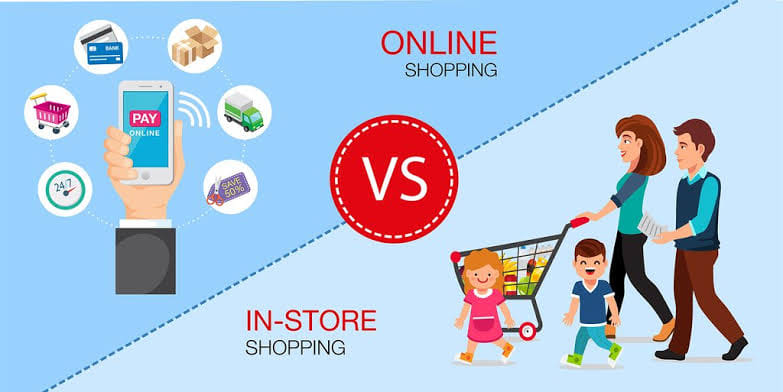
Online vs. In-Store Shopping
In the last few years, people are becoming more interested in online retail and impacting in-store shopping. After COVID-19, people are now more dependent on online shopping to maintain social distance. E-commerce platforms like Amazon, Flipkart are re-shaping the shopping experience. They are allowing consumers to shop from their home/office so that they avoid getting into the market. Let's look at some important points based on online versus in-store shopping.
- Online stores have versatility and accessibility that you just can't create in stores. With an online shopping option, you get the opportunity to browse a vast range of products of different brands in a single day. Also, online stores facilitate options for comparing products, quality, reviews. Online options suggest you check specifications and features at the same time as sopping.
- As per the financial aspect, both online vs. in-store shopping generate significant revenues. Online shopping is a growing market, but an in-store has a considerable number of shoppers that still prefer going to a physical outlet.
- As per the world economy, in the US, 51% of all Americans prefer to do their shopping online. And, around 64% of the total amount spent on shopping in the US is accounted for in-store shopping. But, especially in Africa and the Middle East, in-store shopping is still the first preference of customers.
Is This the End of Brick-and-Mortar?
The emergence of online stores is an influence on local shopping capabilities. There is no doubt, online shopping offers a lot of conveniences and gives consumers an alternative option to go anywhere, to shop for goods at any time.
But both the shopping option online or in-store have their pros and cons. When you're shopping online, you need to search your products by yourself, or you need to call customer service for more help. But in in-store shopping, you will be given one or two attempts by the same shopkeeper. But, as the economy suffers from COVID-19, many retailers are struggling to change shopping preferences and are incorporating online services / retail software to stay competitive in the market.
The effect of Lockdown on Retailers
As per Lalit Bhise, Co-founder, Mobisy Technologies says, “In the weeks following the ‘Janata curfew', sales of all categories of consumer goods were impacted. Certain categories such as beverages and confectionery were wiped out, but few categories such as packaged foods and commodities are weathering the storm better. Local brands and Indian Kirana stores have shown resilience, with the recovery of almost 65 percent by the third week of the lockdown,”
It is important to note that after COVID-19, global consumer behavior has changed from that of retail outlets. While essential commodities remain a major priority. Also, significant changes showed how people spent their money.
As per the survey, more than 95 percent of non-food retailers have closed their outlets after lockdown announced. Also, no revenue is seen during the lockdown, and retailers are not in a position to spend the next six years. The month is expected to earn only 40 percent of the year's revenue.
SwilERP Helps You to Bring Your Business Online
SwilERP is a complete Retail Shop Management Software that offers small and mid-market retailers a complete point-of-sale solution that can be adapted to meet unique retail requirements. The SWIL team has expertise in developing industry-specific software solutions. These software solutions can easily integrate with popular ordering apps offered by other companies in the retail and pharmaceutical business.
Recently we started providing our B2B and B2C mobile apps available to our valued customers. It is our contribution to the world to maintain social distance in the COVID-19 epidemic, which better performs delivery orders and reduces bilateral contact. Also, we are about to launch SWIL ERP, which will extend the functionality of the software and make the software available on the browser. For higher growth, we are soon launching the SWIL APP, specifically designed to facilitate distributors to take orders from their retail customers anytime, anywhere.
Why SwilERP Software?
- Provides flexibility and scalability in all kinds of retail activities
- Automates Sale, Purchase and Inventory management
- Comprehensive and Works across the platform
- Offers centralized control for multi-store retailers
- Specially Designed For Retail Stores & Chains
- Web-based Technology
- Best Selling Software throughout the Country
- Customization according to business requirements
- Product from an ISO 9001:2008 Company
More from the blog
 Distribution & Supply ChainGSTR-2B Reconciliation for Distributors: How to Protect Your ITC Before You File GSTR-3B
How distributors reconcile purchases with GSTR-2B before filing GSTR-3B, fix ITC mismatches, and keep books their CA can trust. India, 2026.
Read article Distribution & Supply ChainGoods Inward Done Right: Matching Every Purchase Order to the GRN in a Distribution Business
Booked one thing, received another? See how PO-to-GRN matching catches shortages, wrong rates and near-expiry stock at goods inward, in one core.
Read article Distribution & Supply ChainSecondary Sales Reporting for Distributors: How to Track Sell-Through Your Principals Can Trust
See real sell-through without a bolt-on DMS. How Indian distributors capture salesman and B2B orders and report secondary sales from one operational core.
Read article PharmacyManaging Expiry Returns in Pharma Distribution: How to Recover Value from Near-Expiry Stock
How pharma distributors handle near-expiry stock, saleable vs non-saleable returns, breakage claims and expiry credit notes without losing money or ITC.
Read article Distribution & Supply ChainMoving from Tally to a Distribution ERP: When You've Outgrown the Books
The honest signs a distributor has outgrown Tally, what a distribution ERP adds, and how to migrate in phases without stopping billing.
Read article Distribution & Supply ChainTablet-Based Picking in the Warehouse: How Device Setup Drives Real-Time Fulfilment Performance
Tablet picking lifts accuracy and live stock visibility, but only if the picker hardware fits the job. Device minimums, zone flows, and fixed-station picking wi…
Read article
- Distribution & Supply ChainGSTR-2B Reconciliation for Distributors: How to Protect Your ITC Before You File GSTR-3B
How distributors reconcile purchases with GSTR-2B before filing GSTR-3B, fix ITC mismatches, and keep books their CA can trust. India, 2026.
Read article - Distribution & Supply ChainGoods Inward Done Right: Matching Every Purchase Order to the GRN in a Distribution Business
Booked one thing, received another? See how PO-to-GRN matching catches shortages, wrong rates and near-expiry stock at goods inward, in one core.
Read article - Distribution & Supply ChainSecondary Sales Reporting for Distributors: How to Track Sell-Through Your Principals Can Trust
See real sell-through without a bolt-on DMS. How Indian distributors capture salesman and B2B orders and report secondary sales from one operational core.
Read article - PharmacyManaging Expiry Returns in Pharma Distribution: How to Recover Value from Near-Expiry Stock
How pharma distributors handle near-expiry stock, saleable vs non-saleable returns, breakage claims and expiry credit notes without losing money or ITC.
Read article - Distribution & Supply ChainMoving from Tally to a Distribution ERP: When You've Outgrown the Books
The honest signs a distributor has outgrown Tally, what a distribution ERP adds, and how to migrate in phases without stopping billing.
Read article - Distribution & Supply ChainTablet-Based Picking in the Warehouse: How Device Setup Drives Real-Time Fulfilment Performance
Tablet picking lifts accuracy and live stock visibility, but only if the picker hardware fits the job. Device minimums, zone flows, and fixed-station picking wi…
Read article