
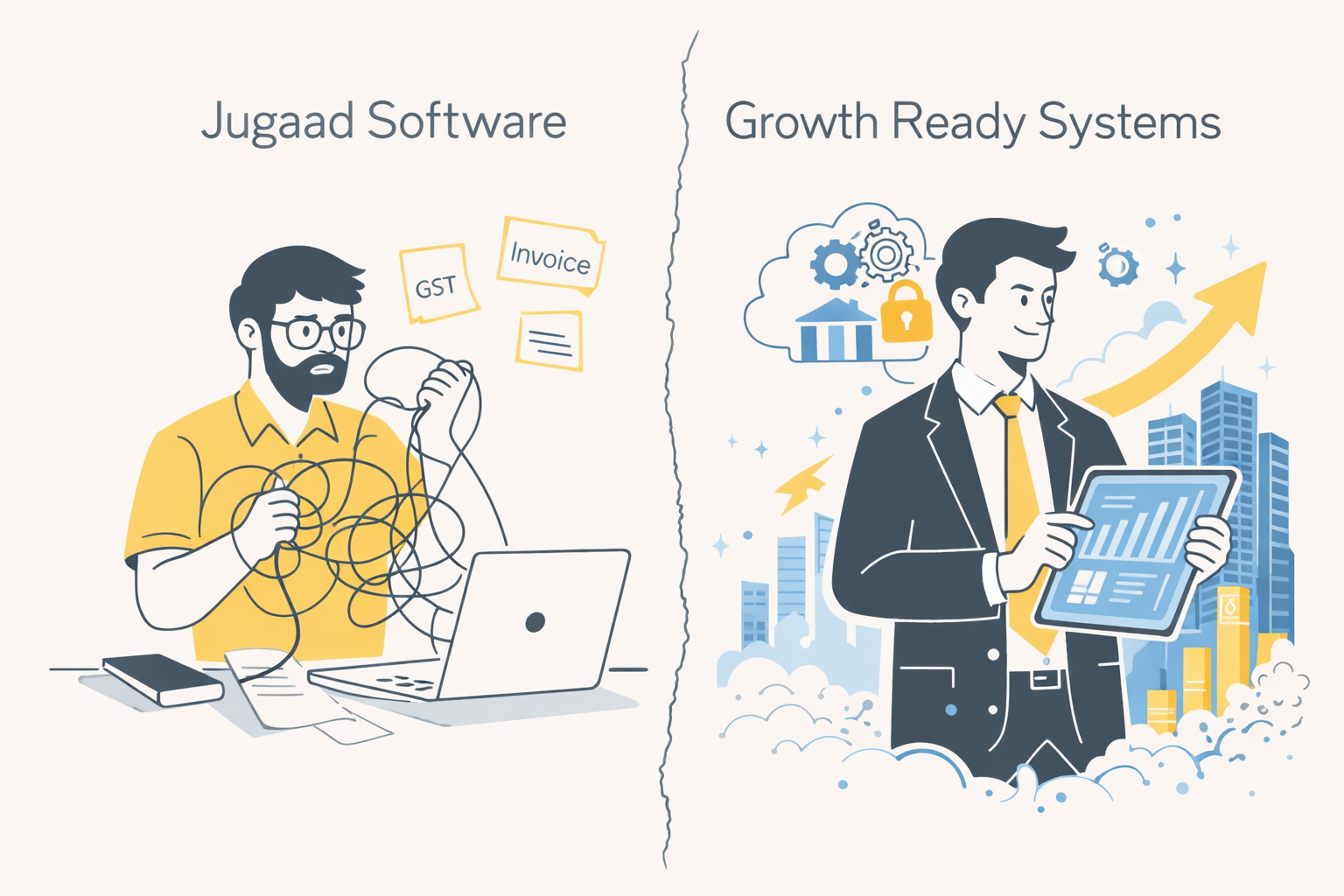
India is known for jugaad.
Creative workarounds. Quick fixes. Making things work with limited resources.
In the early days of a business, jugaad feels smart—even necessary.
But here’s the uncomfortable truth:
The same jugaad mindset that helps Indian businesses start is the reason most of them never scale.
Especially when it comes to software.
Jugaad Works for Survival, Not for Growth
When a business is small, jugaad feels efficient:
- Excel for inventory
- Cheap billing software for invoices
- WhatsApp for coordination
- One person who “knows everything”
- Manual checks instead of systems
It looks cost-effective. It looks flexible.
It even feels like control.
But it’s not control.
It’s fragility disguised as efficiency.
The moment your business grows—more SKUs, more staff, more locations—jugaad starts breaking silently.
The Real Cost of Jugaad Software (That Nobody Calculates)
Most business owners measure software cost like this:
“How cheap is it?”
That’s the wrong question.
The real cost of jugaad software shows up as:
- Dead stock you discover too late
- Profits that look good on paper but don’t exist in cash
- Staff mistakes you can’t trace
- GST stress during audits
- Decisions made on gut feeling, not data
- A business that collapses the moment the owner steps away
None of this shows up on an invoice.
But it shows up every single month.
Cheap Software Is Expensive in Disguise
Jugaad software usually promises:
- “Simple billing”
- “Easy to use”
- “No training required”
- “Very affordable”
What it doesn’t promise (and can’t deliver):
- Visibility
- Accountability
- Scalability
- Process discipline
The result?
You may be busy, but you’re not growing.
You’re working harder, not smarter.
The Owner Dependency Trap
In most Indian businesses running on jugaad software:
- Only the owner understands the full picture
- Only the owner can fix mistakes
- Only the owner can answer key questions
That’s not leadership.
That’s being the most overqualified employee in your own business.
A scalable business runs on systems.
A stuck business runs on people’s memory.
Why “We’ll Fix It Later” Never Comes
Many founders say:
“We’ll upgrade when we grow.”
But growth demands systems.
It doesn’t wait for them.
Without proper software:
- You don’t trust your numbers
- You delay decisions
- You avoid expansion
- You stay comfortable, not competitive
Later never comes—because the chaos keeps increasing.
Jugaad Is a Mindset Problem, Not a Budget Problem
This is important.
Most businesses don’t fail to scale because they can’t afford better software.
They fail because they don’t believe systems matter until it’s too late.
They optimize for:
- Short-term savings
- Minimal change
- Familiar workflows
Scaling requires the opposite:
- Long-term thinking
- Process discipline
- Temporary discomfort
What Scaling Businesses Do Differently
Businesses that scale don’t look for hacks.
They look for clarity.
They ask:
- Can I see my business in real time?
- Can decisions be made without me?
- Can this system handle 2× growth?
- Can mistakes be traced and corrected?
They don’t want software that “just works.”
They want software that forces better behavior.
The Shift Indian Businesses Must Make
The shift is simple, but not easy:
From:
- Jugaad → Systems
- Cheap → Sustainable
- Manual → Visible
- Owner-driven → Process-driven
Jugaad helps you start.
Systems help you scale.
Final Thought
India doesn’t lack entrepreneurs.
It lacks system thinkers.
If your business still depends on:
- Excel
- WhatsApp instructions
- Manual checks
- One person’s presence
You don’t have a scaling problem.
You have a mindset problem.
And no amount of hustle can fix that.
More from the blog
 Distribution & Supply ChainGSTR-2B Reconciliation for Distributors: How to Protect Your ITC Before You File GSTR-3B
How distributors reconcile purchases with GSTR-2B before filing GSTR-3B, fix ITC mismatches, and keep books their CA can trust. India, 2026.
Read article Distribution & Supply ChainGoods Inward Done Right: Matching Every Purchase Order to the GRN in a Distribution Business
Booked one thing, received another? See how PO-to-GRN matching catches shortages, wrong rates and near-expiry stock at goods inward, in one core.
Read article Distribution & Supply ChainSecondary Sales Reporting for Distributors: How to Track Sell-Through Your Principals Can Trust
See real sell-through without a bolt-on DMS. How Indian distributors capture salesman and B2B orders and report secondary sales from one operational core.
Read article PharmacyManaging Expiry Returns in Pharma Distribution: How to Recover Value from Near-Expiry Stock
How pharma distributors handle near-expiry stock, saleable vs non-saleable returns, breakage claims and expiry credit notes without losing money or ITC.
Read article Distribution & Supply ChainMoving from Tally to a Distribution ERP: When You've Outgrown the Books
The honest signs a distributor has outgrown Tally, what a distribution ERP adds, and how to migrate in phases without stopping billing.
Read article Distribution & Supply ChainTablet-Based Picking in the Warehouse: How Device Setup Drives Real-Time Fulfilment Performance
Tablet picking lifts accuracy and live stock visibility, but only if the picker hardware fits the job. Device minimums, zone flows, and fixed-station picking wi…
Read article
- Distribution & Supply ChainGSTR-2B Reconciliation for Distributors: How to Protect Your ITC Before You File GSTR-3B
How distributors reconcile purchases with GSTR-2B before filing GSTR-3B, fix ITC mismatches, and keep books their CA can trust. India, 2026.
Read article - Distribution & Supply ChainGoods Inward Done Right: Matching Every Purchase Order to the GRN in a Distribution Business
Booked one thing, received another? See how PO-to-GRN matching catches shortages, wrong rates and near-expiry stock at goods inward, in one core.
Read article - Distribution & Supply ChainSecondary Sales Reporting for Distributors: How to Track Sell-Through Your Principals Can Trust
See real sell-through without a bolt-on DMS. How Indian distributors capture salesman and B2B orders and report secondary sales from one operational core.
Read article - PharmacyManaging Expiry Returns in Pharma Distribution: How to Recover Value from Near-Expiry Stock
How pharma distributors handle near-expiry stock, saleable vs non-saleable returns, breakage claims and expiry credit notes without losing money or ITC.
Read article - Distribution & Supply ChainMoving from Tally to a Distribution ERP: When You've Outgrown the Books
The honest signs a distributor has outgrown Tally, what a distribution ERP adds, and how to migrate in phases without stopping billing.
Read article - Distribution & Supply ChainTablet-Based Picking in the Warehouse: How Device Setup Drives Real-Time Fulfilment Performance
Tablet picking lifts accuracy and live stock visibility, but only if the picker hardware fits the job. Device minimums, zone flows, and fixed-station picking wi…
Read article