
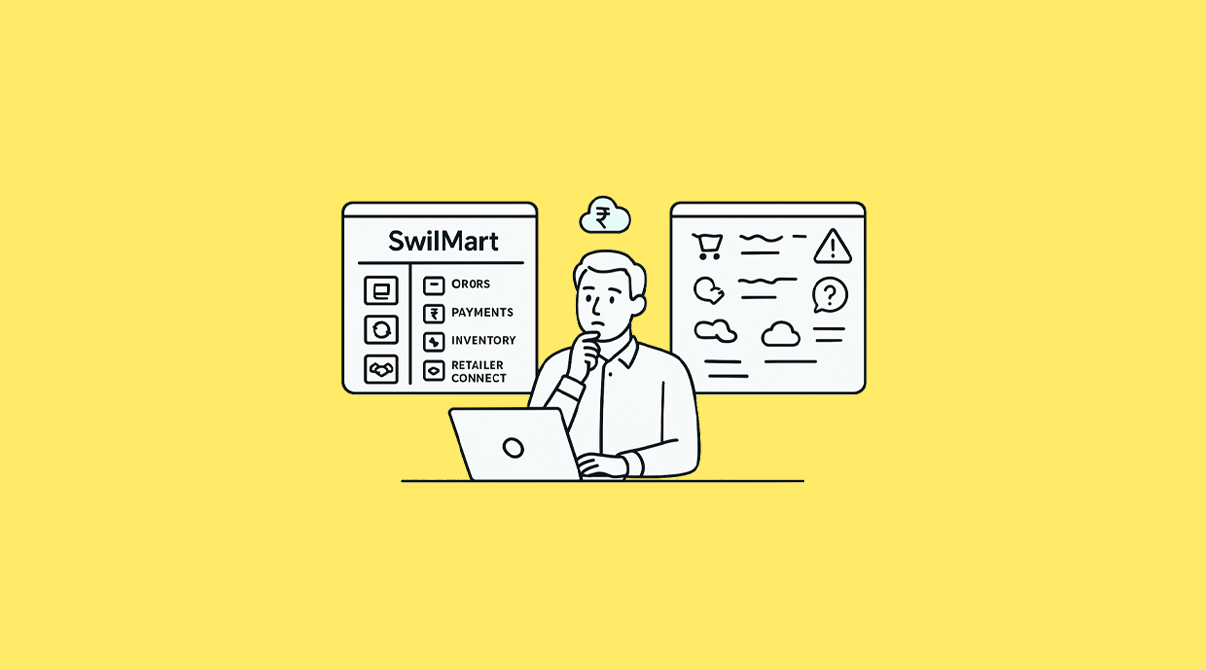
The comparison between SwilMart vs traditional e-commerce platforms helps retailers understand why a B2B-specific solution matters in today’s digital era. Retailers looking to move online often face a tough decision: should they go with big, traditional e-commerce platforms or adopt something purpose-built like SwilMart?
At first glance, both may look similar—an online storefront where customers place orders. But the differences run much deeper, especially for B2B businesses in pharmacy, grocery, and distribution.
Here’s a clear comparison to help you decide.
1. Purpose in SwilMart vs Traditional E-Commerce Platforms (B2B vs B2C)

Traditional E-Commerce Platforms:
- Mostly designed for B2C models, focusing on direct consumer sales.
- Features like shopping carts, reviews, and flashy promotions dominate.
- Less support for bulk orders, dealer pricing, or distributor-retailer workflows.
SwilMart:
- Built specifically for B2B distributors and their retailer network.
- Prioritizes bulk ordering, tier-based pricing, and GST-ready invoicing.
- Retailers can log in, view available stock, and place orders like a professional portal, not a consumer website.
2. ERP Integration in SwilMart vs Traditional Platforms

When comparing SwilMart vs. traditional e-commerce platforms, integration is a major differentiator.
Traditional Platforms:
- Requires third-party plugins or custom development to link with ERP.
- Data often gets duplicated or delayed during sync.
- High risk of mismatched inventory or pricing.
SwilMart:
- Directly connected with SwilERP.
- Orders automatically flow into your system with correct tax, stock, and pricing data.
- No double entries or delays—the data is always live and accurate.
ERP integration is a major factor in deciding between SwilMart vs Traditional E-Commerce Platforms.
3. Retailer Experience

Retailers benefit more from SwilMart’s B2B model than consumer-oriented platforms.
Traditional Platforms:
- Built for consumers, so retailers must “adapt” to a consumer-like flow.
- No access to dealer-specific discounts, payment history, or ledger reports.
- Limited transparency for professional buyers.
SwilMart:
- Designed with retailers in mind.
- Retailers can:
- Place bulk orders.
- Check livestock and prices.
- Track invoices and download reports.
- Creates a professional, transparent relationship between distributor and retailer.
For B2B buyers, SwilMart vs. traditional e-commerce platforms reveals a huge gap in transparency and workflow.
4. Cost and Maintenance

Traditional Platforms:
- Often involve subscription charges, marketplace commissions, or setup costs.
- Custom integration with ERP can add more expense.
- Updates and feature requests usually come with additional development fees.
SwilMart:
- Low setup effort, no commissions.
- Works as an extension of SwilERP, so ongoing costs stay predictable.
- Scales with your retailer base without hidden charges.
5. Control and Branding

Traditional Platforms:
- Marketplaces control branding and customer data.
- Competitors’ products often appear alongside yours.
- Risk of losing customer loyalty to the platform itself.
SwilMart:
- You own the portal and the retailer relationship.
- Your branding, your catalog, your pricing—no competitor intrusion.
- Retailers connect directly to your business, not a third-party marketplace.
The Future of B2B Commerce
The rise of digital transformation is reshaping how distributors and retailers collaborate. The debate of SwilMart vs. traditional e-commerce platforms highlights this shift—businesses now expect connected, data-driven systems rather than generic online stores. In the coming years, integrated ERP platforms like SwilMart will dominate B2B trade by ensuring real-time transparency, automated invoicing, and smooth retailer experiences. Choosing SwilMart today means preparing your business for the next era of intelligent, efficient B2B commerce.
Why Retailers Should Care

The difference comes down to fit. Traditional e-commerce platforms are built for consumer sales, while SwilMart is designed for the way B2B really works—bulk orders, GST compliance, real-time stock, and retailer transparency. Ultimately, SwilMart vs Traditional E-Commerce Platforms isn’t just about going digital — it’s about choosing efficiency, control, and retailer loyalty.
By choosing SwilMart, distributors don’t just “go digital”; they create a professional, ERP-connected ordering experience that saves time, cuts errors, and strengthens retailer loyalty.
✅ Key Thought: If you are a distributor trying to serve retailers, traditional e-commerce platforms will always feel like a compromise. SwilMart is purpose-built for your business, making B2B ordering simple, transparent, and directly connected to your ERP.
More from the blog
 Distribution & Supply ChainGSTR-2B Reconciliation for Distributors: How to Protect Your ITC Before You File GSTR-3B
How distributors reconcile purchases with GSTR-2B before filing GSTR-3B, fix ITC mismatches, and keep books their CA can trust. India, 2026.
Read article Distribution & Supply ChainGoods Inward Done Right: Matching Every Purchase Order to the GRN in a Distribution Business
Booked one thing, received another? See how PO-to-GRN matching catches shortages, wrong rates and near-expiry stock at goods inward, in one core.
Read article Distribution & Supply ChainSecondary Sales Reporting for Distributors: How to Track Sell-Through Your Principals Can Trust
See real sell-through without a bolt-on DMS. How Indian distributors capture salesman and B2B orders and report secondary sales from one operational core.
Read article PharmacyManaging Expiry Returns in Pharma Distribution: How to Recover Value from Near-Expiry Stock
How pharma distributors handle near-expiry stock, saleable vs non-saleable returns, breakage claims and expiry credit notes without losing money or ITC.
Read article Distribution & Supply ChainMoving from Tally to a Distribution ERP: When You've Outgrown the Books
The honest signs a distributor has outgrown Tally, what a distribution ERP adds, and how to migrate in phases without stopping billing.
Read article Distribution & Supply ChainTablet-Based Picking in the Warehouse: How Device Setup Drives Real-Time Fulfilment Performance
Tablet picking lifts accuracy and live stock visibility, but only if the picker hardware fits the job. Device minimums, zone flows, and fixed-station picking wi…
Read article
- Distribution & Supply ChainGSTR-2B Reconciliation for Distributors: How to Protect Your ITC Before You File GSTR-3B
How distributors reconcile purchases with GSTR-2B before filing GSTR-3B, fix ITC mismatches, and keep books their CA can trust. India, 2026.
Read article - Distribution & Supply ChainGoods Inward Done Right: Matching Every Purchase Order to the GRN in a Distribution Business
Booked one thing, received another? See how PO-to-GRN matching catches shortages, wrong rates and near-expiry stock at goods inward, in one core.
Read article - Distribution & Supply ChainSecondary Sales Reporting for Distributors: How to Track Sell-Through Your Principals Can Trust
See real sell-through without a bolt-on DMS. How Indian distributors capture salesman and B2B orders and report secondary sales from one operational core.
Read article - PharmacyManaging Expiry Returns in Pharma Distribution: How to Recover Value from Near-Expiry Stock
How pharma distributors handle near-expiry stock, saleable vs non-saleable returns, breakage claims and expiry credit notes without losing money or ITC.
Read article - Distribution & Supply ChainMoving from Tally to a Distribution ERP: When You've Outgrown the Books
The honest signs a distributor has outgrown Tally, what a distribution ERP adds, and how to migrate in phases without stopping billing.
Read article - Distribution & Supply ChainTablet-Based Picking in the Warehouse: How Device Setup Drives Real-Time Fulfilment Performance
Tablet picking lifts accuracy and live stock visibility, but only if the picker hardware fits the job. Device minimums, zone flows, and fixed-station picking wi…
Read article