
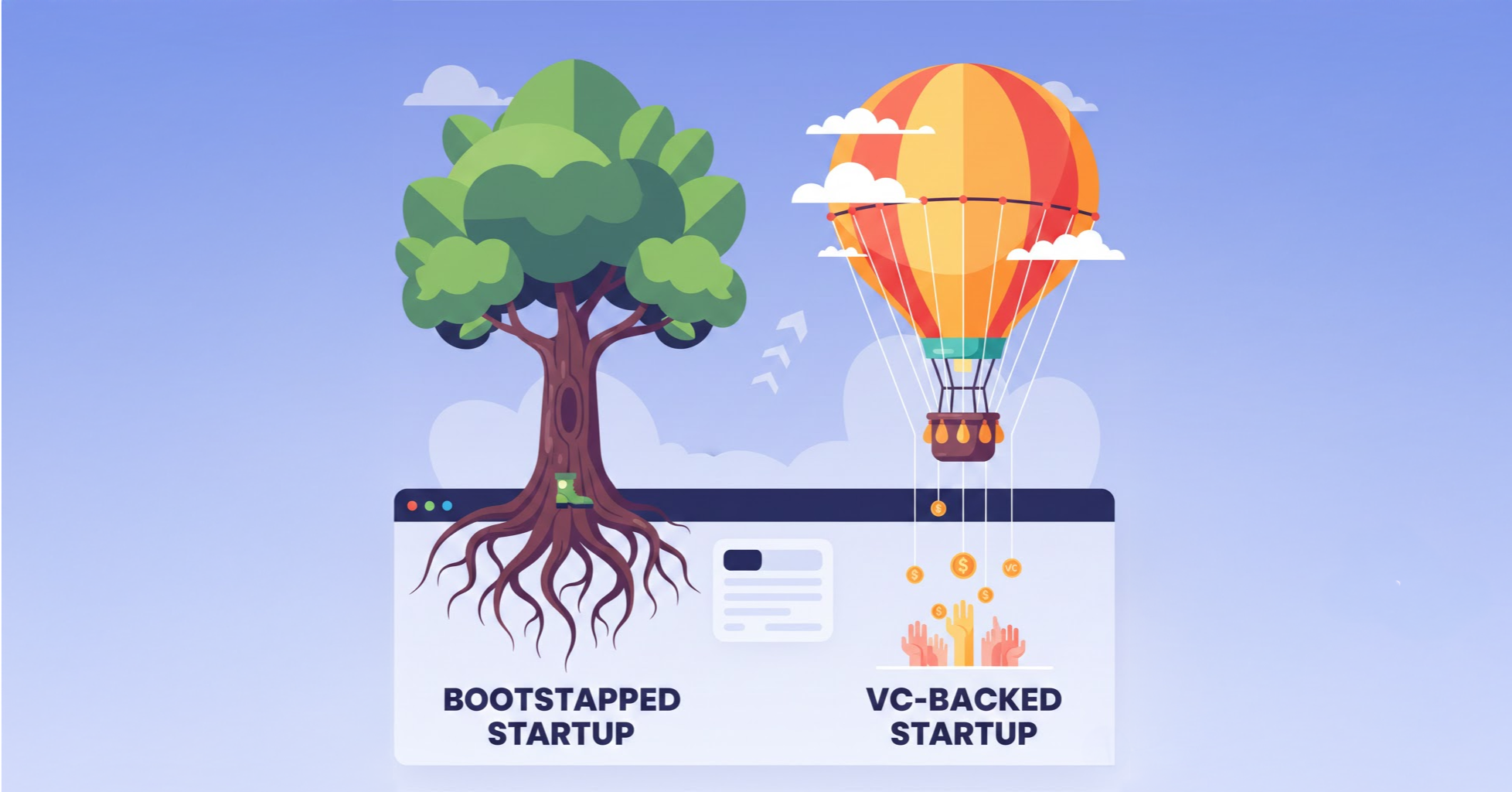
For over a decade, India’s tech landscape has been shaped by two very different philosophies:
- Bootstrapped, customer-funded, profitability-first models
- VC-funded, scale-at-all-costs playbook
Both have built great companies.
But only one model consistently wins in the long run — especially in India’s unique business environment where customers are value-conscious, margins are tight, and founders must build real businesses, not just “valuation stories.”
Let’s break down why bootstrapped tech is becoming India’s preferred winning model, and how it stacks up against the traditional VC playbook.
Why India Loves Bootstrapped Tech Companies
India’s business culture has historically rewarded:
- Positive cash flow
- Lower burn
- Sustainable growth
- Customer-led expansions
- Long-term trust & relationships
The Rise of Bootstrapped Tech in India
Whether it’s Zoho, Zerodha, Wingify, or countless profitable SaaS companies in Tier 2/3 India — these businesses prove that you don’t need VC money to win big.
Key Indian advantages of bootstrapping:
- Customers prefer stable, debt-free, profit-focused companies.
- Decision-making is fast because founders aren’t answerable to boards.
- Products remain closest to actual customer needs, not investor expectations.
- Slow, steady, real growth → unbeatable compounding.
Bootstrapped vs VC Playbook: A Head-to-Head Breakdown
Below is a comparison that reveals why these two mindsets operate very differently.
1. Goal: Profit vs Growth
Bootstrapped Model
Goal: Profitability → Stability → Compound Growth
- Grow using customer revenue, not investor money.
- Build products that solve real, paying problems.
- Expand only when revenue supports it.
- Resilient during downturns.
VC Playbook
Goal: Growth → Market Capture → Profit later (maybe)
- Blitz-scaling: spend now, earn later.
- High burn is considered normal.
- Dependent on market sentiment and funding cycles.
Winner in India: Bootstrapped.
Indian markets do not reward high-burn companies unless they operate in a large consumer space.
2. Product Philosophy: Practical vs Visionary
Bootstrapped
- Build what customers ask for.
- Keep features practical, usable, stable.
- Iterate incrementally.
VC-Funded
- Build for “industry disruption.”
- Add features to increase valuation, not retention.
- Often overshoot real customer needs.
Winner: Bootstrapped — because Indian SMBs value reliability over hype.
3. Customer Relationship: Partnership vs Transaction
Bootstrapped
- Every customer counts — they fund the company.
- Higher customer retention.
- Personalized support & long-term trust.
VC Playbook
- Rapid customer acquisition.
- High churn acceptable; replaced with marketing.
- Relationships are transactional, not partnership-led.
Winner: Bootstrapped — strongest for B2B, SaaS, ERP, and retail tech.
4. Team Culture: Craftsmen vs Employees
Bootstrapped
- Small, lean teams focused on craft.
- Zero politics — founders work with teams directly.
- Talent stays for years.
VC Playbook
- Fast hiring → fast firing.
- Layered structures → slow execution.
- More stakeholders, more opinions.
Winner: Bootstrapped — the team is deeply aligned with product vision.
5. Risk & Survival
Bootstrapped
- Profitable from early years.
- Zero dependency on investor mood.
- High survival rate during crises.
VC Playbook
- High risk of shutdown if funding stops.
- Many unicorns collapse under their own burn.
Winner: Bootstrapped — stability is a moat.
Why Bootstrapped SaaS Wins in Traditional Indian Industries
Bootstrapped tech works exceptionally well in industries like:
- Retail
- Distribution
- Pharma
- Manufacturing
- FMCG
- Hospitality
- Logistics
- E-commerce tools
These industries have:
- Complex, real-world workflows
- Price-sensitive customers
- Huge preference for trust & longevity
- High switching cost
- Low tolerance for unstable products
A flashy, investor-driven SaaS company rarely survives long in such ecosystems.
A bootstrapped, stable, “built with customers” tool thrives.
Why India’s Future Lies in Bootstrapped Tech
India isn’t Silicon Valley.
Here, the winning formula looks like this:
- Build slow
- Build right
- Build for the long term
- Let customers fund expansion
- Keep the team small & focused
- Resist the temptation of "hypergrowth"
As markets mature, Indian founders are realizing that:
A resilient, profitable ₹200 crore company is far more powerful than an unprofitable ₹2,000 crore tech startup.
When Does VC Funding Actually Make Sense?
To be fair — the VC model has its strengths. It works best when:
- The market winner must capture 100M+ users.
- Speed is everything (e.g., fintech, consumer apps).
- Technology requires massive upfront investment (e.g., robotics, biotech).
- You are competing globally and need a head start.
But for India’s SaaS, ERP, retail-tech, and SMB solutions, the bootstrapped model is king.
Which Playbook Should Founders Choose?
Ask yourself:
- Is my customer willing to pay early?
- Can revenue fund my growth?
- Am I solving a practical problem?
- Do I want full control of my company?
- Do I want to build a business or a valuation?
If your answer leans towards stability, control, and long-term brand building —
bootstrapping is your winning play.
Conclusion: The Indian Way Wins
Bootstrapped companies aren’t just surviving—they’re defining the new era of Indian tech.
They’re building profitable, customer-funded, long-lived businesses, while VC-funded peers chase hype cycles.
The future of Indian SaaS belongs to founders who choose:
- Patience over pressure
- Profit over burn
- Craft over chaos
And as more Indian SMBs digitalize, they prefer partners who look like them:
Stable. Grounded. Profitable. Bootstrapped.
More from the blog
 Distribution & Supply ChainGSTR-2B Reconciliation for Distributors: How to Protect Your ITC Before You File GSTR-3B
How distributors reconcile purchases with GSTR-2B before filing GSTR-3B, fix ITC mismatches, and keep books their CA can trust. India, 2026.
Read article Distribution & Supply ChainGoods Inward Done Right: Matching Every Purchase Order to the GRN in a Distribution Business
Booked one thing, received another? See how PO-to-GRN matching catches shortages, wrong rates and near-expiry stock at goods inward, in one core.
Read article Distribution & Supply ChainSecondary Sales Reporting for Distributors: How to Track Sell-Through Your Principals Can Trust
See real sell-through without a bolt-on DMS. How Indian distributors capture salesman and B2B orders and report secondary sales from one operational core.
Read article PharmacyManaging Expiry Returns in Pharma Distribution: How to Recover Value from Near-Expiry Stock
How pharma distributors handle near-expiry stock, saleable vs non-saleable returns, breakage claims and expiry credit notes without losing money or ITC.
Read article Distribution & Supply ChainMoving from Tally to a Distribution ERP: When You've Outgrown the Books
The honest signs a distributor has outgrown Tally, what a distribution ERP adds, and how to migrate in phases without stopping billing.
Read article Distribution & Supply ChainTablet-Based Picking in the Warehouse: How Device Setup Drives Real-Time Fulfilment Performance
Tablet picking lifts accuracy and live stock visibility, but only if the picker hardware fits the job. Device minimums, zone flows, and fixed-station picking wi…
Read article
- Distribution & Supply ChainGSTR-2B Reconciliation for Distributors: How to Protect Your ITC Before You File GSTR-3B
How distributors reconcile purchases with GSTR-2B before filing GSTR-3B, fix ITC mismatches, and keep books their CA can trust. India, 2026.
Read article - Distribution & Supply ChainGoods Inward Done Right: Matching Every Purchase Order to the GRN in a Distribution Business
Booked one thing, received another? See how PO-to-GRN matching catches shortages, wrong rates and near-expiry stock at goods inward, in one core.
Read article - Distribution & Supply ChainSecondary Sales Reporting for Distributors: How to Track Sell-Through Your Principals Can Trust
See real sell-through without a bolt-on DMS. How Indian distributors capture salesman and B2B orders and report secondary sales from one operational core.
Read article - PharmacyManaging Expiry Returns in Pharma Distribution: How to Recover Value from Near-Expiry Stock
How pharma distributors handle near-expiry stock, saleable vs non-saleable returns, breakage claims and expiry credit notes without losing money or ITC.
Read article - Distribution & Supply ChainMoving from Tally to a Distribution ERP: When You've Outgrown the Books
The honest signs a distributor has outgrown Tally, what a distribution ERP adds, and how to migrate in phases without stopping billing.
Read article - Distribution & Supply ChainTablet-Based Picking in the Warehouse: How Device Setup Drives Real-Time Fulfilment Performance
Tablet picking lifts accuracy and live stock visibility, but only if the picker hardware fits the job. Device minimums, zone flows, and fixed-station picking wi…
Read article