
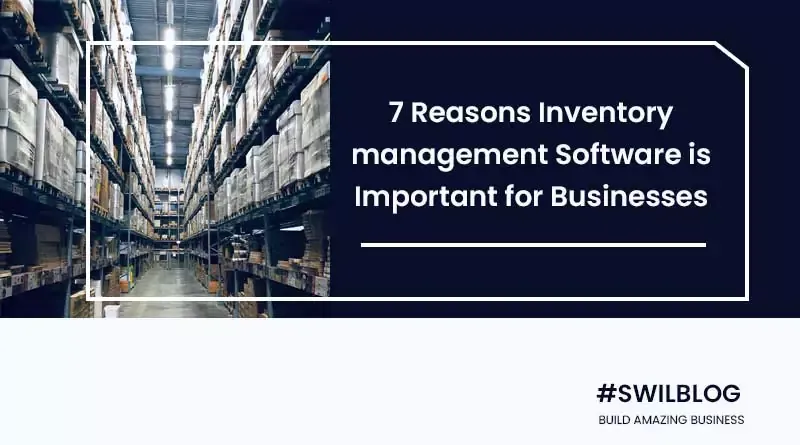
Warehouse management software gives any business a clear idea of inventory management in real-time. It enhances the level of tracking the flow of business stocks at any place in the world.
It identifies the bottlenecks and opportunities for business. Increases the speed of your businesses without making errors and gives hassle-free ways to work.
To help you find the best warehouse management software and its effectiveness in business, I am going to share some facts and thoughts here.
Warehouse Management System
When your business deals with selling goods, you need to have a place where you store your stocks. This place can be a warehouse. For this, you need to invest in facilities, hire staff for monitoring, and do whatever you need to.
However, without proper warehouse management, you cannot determine how successful a business will be.
Inefficient warehouse management leads to poor performing staff, a low-profit margin, high operating/logistics costs, and damaged customer relationships.
Thus, warehouse management software is a necessity. The software is designed to optimize the processes involved in managing the warehouse. It gives businesses complete visibility into real-time inventory levels and warehousing, employee productivity, demand forecasting, and order fulfillment workflows within a warehouse.
Essential Facts on Warehouse Management Software
- It eliminates manual processes and guesswork. It automates management processes that save time and give visibility to what is happening inside the warehouse.
- It helps business owners to identify business areas that need improvement. Accordingly, it promotes optimization in warehouse management.
- It helps businesses to monitor their day-to-day activity and reduces the complexity of handling various items.
- It speeds up the ordering and delivery process, which plays a vital role in making the customer happy.
Well, here are 7 realistic reasons why WMS software is essential for businesses
Top Warehouse Management System Software Benefits
1. Better stock control with better stock visibility
Better stock visibility is an essential feature that every warehouse management system provides. It enables businesses to get real-time data on stock availability, sales, and purchases. It can be tracked with technologies like barcode, serial number, and RFID tagging, etc.
This visibility provides insight into which products are popular among customers and which are not. In this way, it helps businesses to predict demand.
In this way, you can enhance inventory management by reducing stock levels, improving order fulfillment, and reducing order cycle times.
2. Find bottlenecks and solve them quickly
Warehouse software gives businesses the ability to analyze problematic areas. It identifies the areas that can be improved by making improvements or by adding new features. The software manages the day-to-day activity of your business and keeps a record of everything at your fingertips.
Additionally, you'll be able to get everything in real-time. In this way, you are able to detect all the bottlenecks and take appropriate action to resolve them.
Therefore, an efficient WMS can improve management. Can help reduce delivery times by facilitating inventory movement and improving record accuracy.
3. Provide better customer service and return on investment
The warehouse management system streamlines the operations associated with inventory management and enhances the customer buying experience.
It ensures that enough stock is available in the warehouse and avoids any chaos in delivering goods. Also, it reduces the waiting time that any customer spends on billing queues.
This way, it improves your sales and increases profits by enabling you to sell more with speed and accuracy. This gives happier customers.
4. Ensure Customer Satisfaction & Prompt Order Fulfillment
Customer satisfaction is directly related to order fulfillment. Warehouse Management Software provides businesses with a tracking system that lets them know the sales/purchase/billing/invoice/delivery details of each company in just one click.
You get all the reports through the software and determine what are important/insignificant, fake/genuine, in-demand products/non-demanded products, etc.
This way, you enhance your communication with your customer and know exactly what they want and when.
5. Reduce operating expenses
A well-designed warehouse management system gives businesses many ways to reduce operating expenses. It is capable of separating perishable or expired inventory. Accordingly, it makes a plan to organize them.
A smart WMS can easily determine where to place the items/products in a more customized way. It facilitates better shelf management and pricing management to eliminate the potential for wastage of labor, space, money, and time.
In this way, the WMS can calculate the optimal location for each item to ensure that all places are fully utilized for the pickup and put away effort.
6. Increase warehouse productivity by optimizing warehouse space
An effective warehousing operation comes with shelf management. It allows for proper control of the number of items stored and maximizes warehousing by properly arranging your warehouse. It set the stocks with their attributes based on color, brand, size, perishable, non-perishable items.
This way, a warehouse management system is designed to track items with details like sell-by-date, assembly, packing and shipping point, and more. Hence, your inventory holding costs can be reduced.
7. Increase security and protect against theft
Warehouse theft is a serious concern. It comes not only from external sources but also from internal sources (staff). Thus, there is a need to set up a system that works to prevent both internal and external theft.
The warehouse management system is capable of keeping records of all the stock groups in every way. It gives businesses a solution for every risk factor. It helps you with theft prevention, access control, surveillance, disaster recovery, data security, and environmental monitoring.
Can Your Warehouse Operation Get Better With SwilERP?
SwilERP provides a highly efficient, advanced warehouse management system to help businesses save time and increase productivity. It eliminates paperwork and gives your business a solution for making full use of your inventory. This way, it ensures no or very little wastage.
You can consider SwilERP as the best warehouse management system. It helps you solve many warehouse management issues with accuracy, visibility, productivity, and error reduction. For more details, kindly visit swindia.com
More from the blog
 Distribution & Supply ChainGSTR-2B Reconciliation for Distributors: How to Protect Your ITC Before You File GSTR-3B
How distributors reconcile purchases with GSTR-2B before filing GSTR-3B, fix ITC mismatches, and keep books their CA can trust. India, 2026.
Read article Distribution & Supply ChainGoods Inward Done Right: Matching Every Purchase Order to the GRN in a Distribution Business
Booked one thing, received another? See how PO-to-GRN matching catches shortages, wrong rates and near-expiry stock at goods inward, in one core.
Read article Distribution & Supply ChainSecondary Sales Reporting for Distributors: How to Track Sell-Through Your Principals Can Trust
See real sell-through without a bolt-on DMS. How Indian distributors capture salesman and B2B orders and report secondary sales from one operational core.
Read article PharmacyManaging Expiry Returns in Pharma Distribution: How to Recover Value from Near-Expiry Stock
How pharma distributors handle near-expiry stock, saleable vs non-saleable returns, breakage claims and expiry credit notes without losing money or ITC.
Read article Distribution & Supply ChainMoving from Tally to a Distribution ERP: When You've Outgrown the Books
The honest signs a distributor has outgrown Tally, what a distribution ERP adds, and how to migrate in phases without stopping billing.
Read article Distribution & Supply ChainTablet-Based Picking in the Warehouse: How Device Setup Drives Real-Time Fulfilment Performance
Tablet picking lifts accuracy and live stock visibility, but only if the picker hardware fits the job. Device minimums, zone flows, and fixed-station picking wi…
Read article
- Distribution & Supply ChainGSTR-2B Reconciliation for Distributors: How to Protect Your ITC Before You File GSTR-3B
How distributors reconcile purchases with GSTR-2B before filing GSTR-3B, fix ITC mismatches, and keep books their CA can trust. India, 2026.
Read article - Distribution & Supply ChainGoods Inward Done Right: Matching Every Purchase Order to the GRN in a Distribution Business
Booked one thing, received another? See how PO-to-GRN matching catches shortages, wrong rates and near-expiry stock at goods inward, in one core.
Read article - Distribution & Supply ChainSecondary Sales Reporting for Distributors: How to Track Sell-Through Your Principals Can Trust
See real sell-through without a bolt-on DMS. How Indian distributors capture salesman and B2B orders and report secondary sales from one operational core.
Read article - PharmacyManaging Expiry Returns in Pharma Distribution: How to Recover Value from Near-Expiry Stock
How pharma distributors handle near-expiry stock, saleable vs non-saleable returns, breakage claims and expiry credit notes without losing money or ITC.
Read article - Distribution & Supply ChainMoving from Tally to a Distribution ERP: When You've Outgrown the Books
The honest signs a distributor has outgrown Tally, what a distribution ERP adds, and how to migrate in phases without stopping billing.
Read article - Distribution & Supply ChainTablet-Based Picking in the Warehouse: How Device Setup Drives Real-Time Fulfilment Performance
Tablet picking lifts accuracy and live stock visibility, but only if the picker hardware fits the job. Device minimums, zone flows, and fixed-station picking wi…
Read article